Lesson Overview
This lesson introduces learners to the Pythagorean Theorem and its use in calculating distances between two points on a Cartesian plane. Learners will explore right-angled triangles, distance calculations, and practical applications of the theorem in mathematics, computing, engineering, navigation, and automation systems.
Lesson Outcomes
After completing this lesson, learners will be able to:
- Explain the Pythagorean Theorem
- Identify the sides of a right-angled triangle
- Calculate missing side lengths using the theorem
- Determine the distance between two points on a Cartesian plane
- Apply distance calculations in technology and computing environments
KT0601: Introduction to the Pythagorean Theorem
The Pythagorean Theorem is a mathematical rule used to calculate the relationship between the sides of a right-angled triangle.
A right-angled triangle contains one angle equal to:
90º
The theorem states:
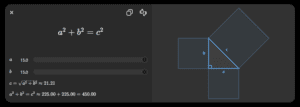
Where:
- a = length of one side
- b = length of the second side
- c = length of the hypotenuse
The hypotenuse is always:
- The longest side of the triangle
- Opposite the right angle
The theorem is used to:
- Calculate distances
- Solve geometric problems
- Analyse coordinate systems
- Support engineering and computing calculations
KT0602: Identifying the Sides of a Right-Angled Triangle
Understanding the sides of a right-angled triangle is important before applying the theorem.
Hypotenuse
The hypotenuse:
- Is the longest side
- Opposite the right angle
- Represented by c
Other Two Sides
The remaining sides are represented by:
- a
- b
These sides form the right angle.
Example Triangle
Suppose:
a = 3b = 4
To find the hypotenuse:
3² + 4² = c²
Step 1:
9 + 16 = c²
Step 2:
25 = c²
Step 3:
c = √25
Final Answer:
c=5
Therefore, the hypotenuse is 5 units long.
KT0603: Calculating Distance Between Two Points
The Pythagorean Theorem can be used to calculate the distance between two points on a Cartesian plane.
The distance formula is derived from the theorem:
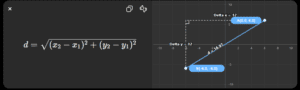
Where:
- (x₁ ,y₁ ) = first point
- (x₂ ,y₂ ) = second point
- d = distance
Example 1
Find the distance between:
(2,3)
and
(6,6)
Step 1: Identify Values
x₁ =2
y₁ =3
x₂ =6
y₂ =6
Step 2: Substitute into Formula
d = √(6−2)²+(6−3)²
Step 3: Solve Differences
d = √4² + 3²
Step 4: Square Values
d = √16 + 9
Step 5: Add Values
d = √25
Step 6: Find Square Root
d = 5
Final Answer:
The distance between the two points is:
5 units
KT0604: Applications of Distance Calculations
Distance calculations are important in many technological and automation environments.
GPS and Navigation
Navigation systems calculate distances between locations using coordinate systems and mathematical formulas.
Applications include:
- Route planning
- Delivery tracking
- Mapping software
Robotics
Robots use distance calculations to:
- Move accurately
- Avoid obstacles
- Navigate environments
- Calculate movement paths
Computer Graphics
Computer graphics systems use coordinates and distance calculations to:
- Position objects
- Detect collisions
- Create animations
- Render visual effects
Engineering and Design
Engineers use distance calculations in:
- Construction
- Technical drawings
- Architecture
- CAD systems
Game Development
Video games use coordinate systems and distance calculations for:
- Character movement
- Object interaction
- Camera positioning
- Physics simulations
KT0605: Importance of Accurate Distance Calculations
Accurate distance calculations are important because errors may affect:
- Navigation systems
- Automated machines
- Robotics
- Engineering measurements
- Data visualisation
- Mapping systems
Incorrect calculations may result in:
- Navigation failures
- Incorrect positioning
- System errors
- Safety risks
Automation and technology systems rely heavily on mathematical accuracy to function correctly.
Understanding the Pythagorean Theorem and distance formulas helps learners build foundational mathematical skills used in:
- Programming
- Robotics
- Automation
- Engineering
- Data systems
- Computer graphics