
Occupational Skills Programme: Eco-Ranger
About Course
1. COURSE INTRODUCTION SECTION
1.1 Course Synopsis
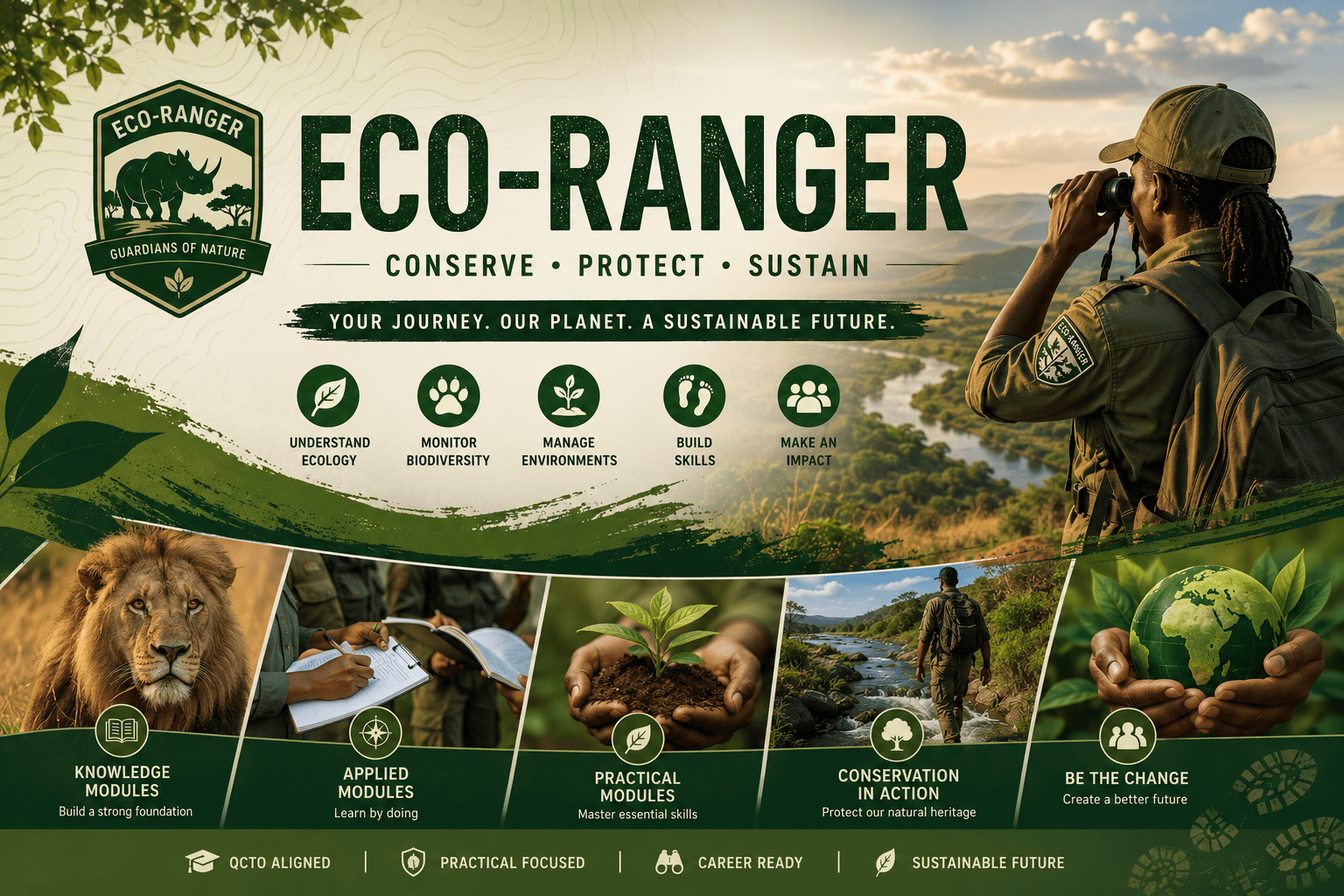
The Eco-Ranger Occupational Skills Programme prepares learners to support biodiversity conservation and the protection of natural resources, plants and animal species within and outside protected areas.
The programme introduces learners to the ecological principles, conservation practices, monitoring methods, legislation, navigation systems, communication tools and safety procedures required when working in wildlife and environmental conservation environments.
The programme is relevant to South Africa’s conservation, environmental management, wildlife protection and eco-tourism sectors. Eco-Rangers contribute to the monitoring of ecosystems, identification of environmental risks, protection of wildlife and responsible management of natural resources.
The course supports learners who want to enter or develop within conservation-related work, including opportunities in protected areas, nature reserves, environmental organisations, eco-tourism operations and community-based conservation projects.
1.2 About the Course
The Eco-Ranger programme provides learners with the theoretical knowledge and practical skills required to perform biodiversity monitoring and conservation-support activities.
Learners will study the relationships between living organisms and their environments, the functioning and resilience of ecosystems, African wildlife, conservation legislation, biodiversity monitoring, catchment systems, natural-resource management, navigation, radio communication and eco-tourism.
The theoretical component builds the learner’s understanding of:
- Ecology and ecosystem functioning
- Conservation principles
- Wildlife identification and behaviour
- Human and wildlife interactions
- Conservation legislation and enforcement procedures
- Biodiversity monitoring principles and methods
- Invasive alien species
- Catchment systems and natural resources
- Maps, GPS, GIS and navigation
- Two-way radio communication
- Eco-tourism and biodiversity conservation
- Personal safety and survival measures
The practical component allows learners to apply this knowledge through activities such as:
- Conducting wildlife patrols
- Preparing and using conservation tools and equipment
- Implementing invasive alien species control activities
- Collecting biodiversity, habitat and natural-resource data
- Locating species and habitats using maps, GPS and GIS
- Communicating field information using two-way radios
- Responding to emergencies in wildlife environments
- Compiling evidence of completed practical work
The programme aligns learning with the occupational responsibilities of an Eco-Ranger. Learners are prepared to monitor biodiversity, assist with field surveys, support wildlife protection, control invasive alien species, monitor natural resources and carry out conservation duties safely.
1.3 Course Overview
The course follows a structured learning pathway that combines knowledge development with practical application.
Learners begin by developing a basic understanding of ecology, ecosystems and conservation principles. They then progress to wildlife conservation, conservation legislation, personal safety, biodiversity monitoring and natural-resource management.
The programme later introduces navigation and communication systems, including maps, GPS, GIS and two-way radios. Learners also study the relationship between eco-tourism and biodiversity conservation.
Once the required theoretical knowledge has been developed, learners apply it through practical conservation activities. These activities include wildlife patrols, invasive alien species control, conservation data collection, GIS-based location activities, radio communication and emergency response.
The learning pathway progresses through the following stages:
- Understanding ecology and ecosystems
- Understanding wildlife and conservation
- Applying conservation legislation and procedures
- Recognising hazards and applying safety measures
- Monitoring biodiversity and environmental conditions
- Managing catchment areas and natural resources
- Using navigation and communication systems
- Understanding eco-tourism and biodiversity
- Applying knowledge through practical conservation activities
- Demonstrating competence through formative and summative assessments
The course is delivered through a combination of:
- Facilitated theoretical learning
- Individual and group learning activities
- Case studies and conservation scenarios
- Practical demonstrations
- Simulated activities
- Field-based or workplace activities
- Formative assessments
- Module summative assessments
- Portfolio of Evidence activities
This combination allows learners to understand conservation concepts and demonstrate how those concepts are applied in real or simulated conservation environments. QCTO skills programmes are occupationally directed and place an emphasis on practical, simulated and workplace-related learning.
1.4 Learning Outcomes
After completing the Eco-Ranger programme, learners should be able to:
- Apply ecological principles to the conservation of biological diversity.
- Explain how ecosystems function and respond to environmental changes.
- Explain the importance of ecosystem resilience in biodiversity conservation.
- Identify selected African wildlife species and describe their behaviour.
- Explain interactions between people, wildlife and conservation environments.
- Apply wildlife conservation knowledge when supporting conservation activities.
- Recognise threatened, endangered and vulnerable wildlife species.
- Explain actions used to conserve threatened and endangered species.
- Identify activities that may contravene conservation legislation.
- Follow appropriate procedures when reporting illegal conservation-related activities.
- Apply self-protection and survival measures during emergency situations.
- Explain the purpose and principles of biodiversity monitoring.
- Conduct basic biodiversity monitoring activities.
- Identify and report changes affecting species, habitats and natural resources.
- Identify invasive alien species and explain their environmental impact.
- Assist with the implementation of an approved invasive alien species control programme.
- Explain the role of catchment systems in biodiversity conservation.
- Monitor catchment areas and natural resources.
- Contribute to the rehabilitation and restoration of affected natural resources.
- Read and interpret maps used in conservation environments.
- Use GPS and basic GIS applications to locate species, habitats and natural resources.
- Use two-way radio communication systems according to operational procedures.
- Explain how eco-tourism can support biodiversity conservation.
- Use appropriate tools and equipment when conducting wildlife patrols.
- Collect and record biodiversity, habitat and natural-resource data.
- Submit collected field data to the responsible person.
- Respond appropriately to emergencies in wildlife conservation environments.
- Maintain personal safety and contribute to the safety of others and wildlife during conservation activities.
1.5 Target Audience
The Eco-Ranger programme is suitable for:
- School leavers and matriculants interested in conservation and environmental sustainability
- Aspiring Eco-Rangers
- Entry-level conservation workers
- Community members involved in conservation initiatives
- Individuals involved in community-based natural-resource management
- Rural farmers who want to improve their understanding of conservation and environmental management
- Field Rangers who want to expand their biodiversity-monitoring skills
- Environmental monitors
- Eco-tourism employees
- Individuals already working in conservation or environmental management
- Learners who want to pursue further education or employment in the conservation sector
1.6 Course Requirements
Entry Requirements
Learners must meet one of the following entry requirements:
- An NQF Level 3 qualification with Mathematics or Mathematical Literacy; or
- A minimum of two years of experience in the wildlife conservation sector.
Learning Requirements
Learners should also be prepared to:
- Participate in theoretical and practical learning activities.
- Work individually and as part of a conservation team.
- Participate in simulated or field-based conservation activities.
- Follow health, safety and environmental procedures.
- Use conservation tools and equipment under supervision.
- Complete formative and summative assessments.
- Compile and maintain a Portfolio of Evidence.
- Record practical activities accurately.
- Follow the instructions of facilitators, assessors, mentors and workplace supervisors.
Where practical activities are conducted, learners will require supervised access to the relevant conservation environment, tools, equipment and technology. This may include maps, GPS devices, GIS software, two-way radios, data-collection tools and personal protective equipment.
1.7 Skills You’ll Gain
By completing this course, learners will develop skills in:
- Ecological observation
- Biodiversity monitoring
- Wildlife identification
- Wildlife behaviour observation
- Conservation law awareness
- Recognition and reporting of illegal activities
- Wildlife patrol procedures
- Invasive alien species control
- Environmental data collection
- Field-record completion
- Habitat monitoring
- Natural-resource monitoring
- Catchment-area monitoring
- Map reading
- GPS navigation
- Basic GIS application
- Two-way radio communication
- Eco-tourism awareness
- Conservation tool and equipment preparation
- Personal safety and self-protection
- Emergency response
- Risk identification
- Problem-solving
- Teamwork
- Field communication
- Environmental responsibility
- Portfolio of Evidence compilation
1.8 Course Structure
The Eco-Ranger programme consists of eight Knowledge Modules and five Practical Modules.
Knowledge Modules
| Module | Module Title | Type | NQF Level | Credits |
|---|---|---|---|---|
| KM-01 | Ecological Principles and Ecosystem Resilience | Knowledge | 3 | 3 |
| KM-02 | Wildlife Conservation | Knowledge | 4 | 3 |
| KM-03 | Nature Conservation Law and Enforcement | Knowledge | 4 | 3 |
| KM-04 | Self-Protection and Survival Measures | Knowledge | 4 | 3 |
| KM-05 | Biodiversity Monitoring | Knowledge | 4 | 8 |
| KM-06 | Catchment Areas and Natural Resources Management | Knowledge | 4 | 5 |
| KM-07 | Navigation and Communications | Knowledge | 3 | 5 |
| KM-08 | Eco-Tourism and Biodiversity | Knowledge | 4 | 6 |
| Knowledge Module Total | 36 |
Practical Modules
| Module | Module Title | Type | NQF Level | Credits |
| PM-01 | Wildlife Patrols | Practical | 4 | 5 |
| PM-02 | Invasive Alien Species Control | Practical | 4 | 2 |
| PM-03 | Conservation Data Collection | Practical | 4 | 5 |
| PM-04 | GIS and Two-Way Radio Communication | Practical | 4 | 5 |
| PM-05 | Self-Protection | Practical | 4 | 7 |
| Practical Module Total | 24 |
Programme Credit Summary
| Component | Credits |
| Knowledge Modules | 36 |
| Practical Modules | 24 |
| Total Programme Credits | 60 |
Course Content
KM-01: Ecological Principles and Ecosystem Resilience
KM-02: Wildlife Conservation
KM-03: Nature Conservation Law and Enforcement
KM-04: Self-Protection and Survival Measures
KM-05: Biodiversity Monitoring
KM-06: Catchment Areas and Natural Resources Management
KM-07: Navigation and Communications
KM-08: Eco-Tourism and Biodiversity
AM-01: Wildlife Patrols
AM-02: Invasive Alien Species Control
AM-03: Conservation Data Collection
AM-04: GIS and Two-Way Radio Communication
AM-05: Self-Protection
Earn a certificate
Add this certificate to your resume to demonstrate your skills & increase your chances of getting noticed.

Student Ratings & Reviews