
Occupational Certificate: Supply Chain Practitioner
About Course
1. Course Introduction Section
1.1 Course Synopsis
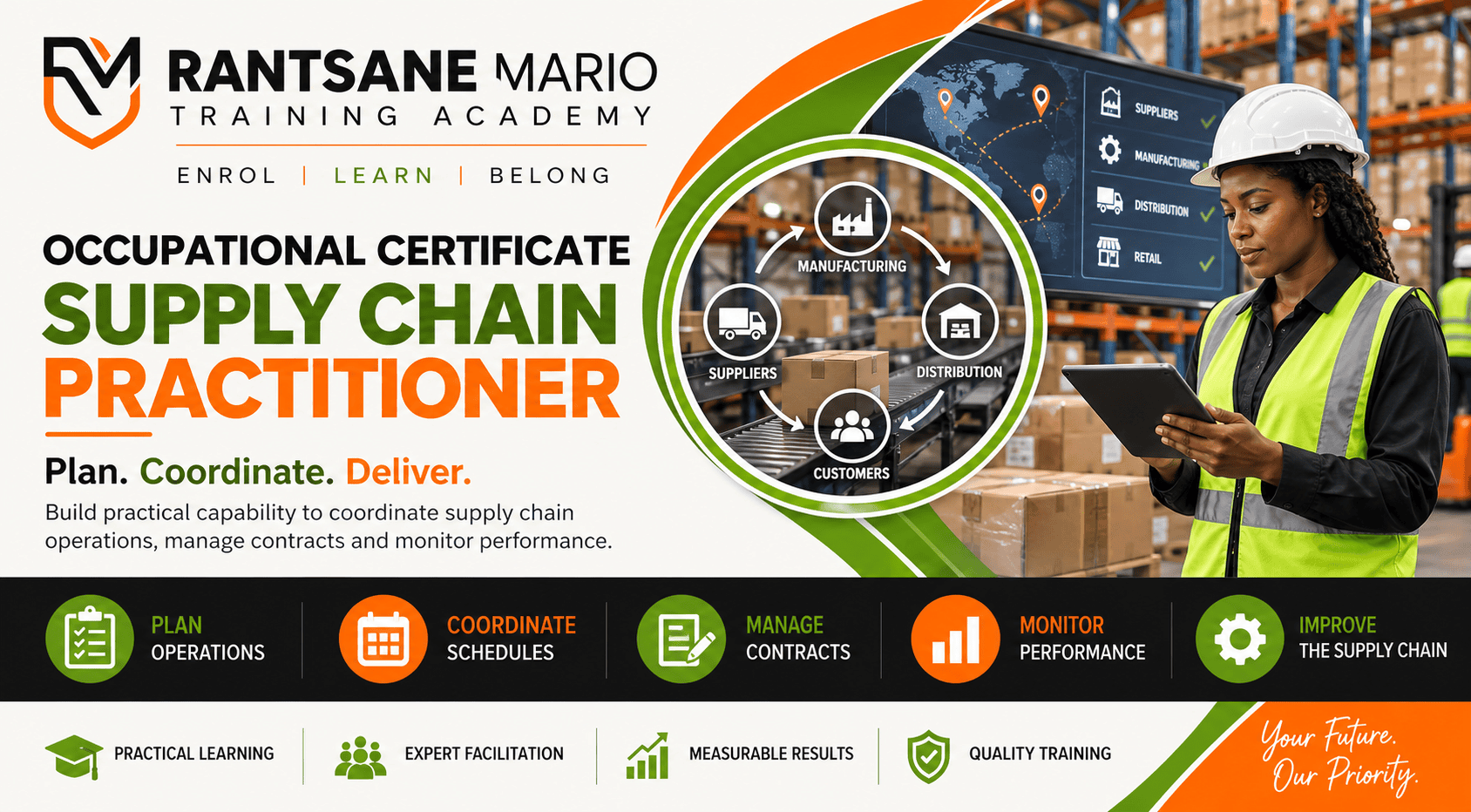
The Occupational Certificate: Supply Chain Practitioner prepares learners to develop, coordinate and monitor operational schedules across the supply chain.
The qualification develops the knowledge, practical skills and workplace experience required to coordinate supply chain activities, manage customer and supplier relationships, monitor operational performance and support effective service delivery.
Learners develop competence across:
- Demand execution
- Customer service
- Transport and distribution
- Inventory management
- Warehousing
- Production
- Procurement
- Returns management
- Contract management
- Operational performance monitoring
The qualification is relevant to organisations operating in:
- Procurement and supply
- Logistics
- Transport and distribution
- Warehousing
- Manufacturing
- Retail
- Wholesale
- Customer fulfilment
- Public-sector supply chains
- Private-sector supply chains
1.2 About the Course
The Occupational Certificate: Supply Chain Practitioner combines theoretical knowledge, practical application and structured workplace experience.
The knowledge component develops understanding of:
- Supply chain concepts and processes
- Customer and end-user relationships
- Customer service and order management
- Transport and distribution operations
- Inventory management and optimisation
- Warehousing and facilities
- Production planning and control
- Procurement and supply operations
- Returns management
- Performance improvement
- Contract management
- Project management principles
The practical component develops competence in:
- Preparing operational schedules
- Coordinating supply chain schedules
- Managing contract implementation
- Monitoring service-level agreements
- Monitoring customer orders and service delivery
- Monitoring transport, warehousing and production activities
- Monitoring procurement and supply activities
The workplace component provides supervised experience in:
- Preparing operational schedules
- Coordinating schedule implementation
- Managing contract implementation
- Monitoring operational activities
- Evaluating supply chain performance
1.3 Course Overview
The programme progresses through three integrated components:
Knowledge Modules
These provide the theoretical understanding required to plan, coordinate and monitor supply chain operations.
Practical Skills Modules
These allow learners to apply their knowledge through practical supply chain activities and evidence-producing tasks.
Work Experience Modules
These provide structured workplace exposure under appropriate supervision.
The learning pathway progresses through:
- Understanding integrated supply chain management
- Managing demand execution and customer relationships
- Planning transport and distribution activities
- Managing inventory
- Coordinating warehousing and facilities
- Planning production operations
- Managing procurement activities
- Managing returns
- Monitoring contracts and operational performance
- Preparing and coordinating operational schedules
- Evaluating supply chain execution
- Applying skills in a workplace environment
1.4 Learning Outcomes
After completing the qualification, learners should be able to:
- Explain supply chain concepts and management processes.
- Manage customer and end-user relationships.
- Coordinate customer orders and service delivery.
- Explain transport and distribution operations.
- Apply inventory-management and optimisation principles.
- Explain warehousing and facilities operations.
- Coordinate production operations.
- Apply procurement and supply principles.
- Coordinate returns-management activities.
- Apply contract-management principles.
- Monitor service-level agreements.
- Apply project-management principles to supply chain activities.
- Translate operational plans into operational schedules.
- Coordinate supply chain operational schedules.
- Monitor demand-execution activities.
- Monitor transport, warehousing and production activities.
- Monitor procurement and supply activities.
- Evaluate supply chain operational performance.
- Manage operational non-compliance.
- Develop and coordinate supply chain operational plans and schedules.
- Assess the execution of supply chain operational schedules.
1.5 Target Audience
The qualification is suitable for:
- Aspiring Supply Chain Practitioners
- Supply chain administrators
- Logistics coordinators
- Procurement personnel
- Inventory controllers
- Warehouse coordinators
- Transport and distribution personnel
- Production-planning personnel
- Customer-service personnel
- Order-fulfilment personnel
- Contract-administration personnel
- Employees seeking formal recognition of supply chain experience
- Learners seeking entry into a supply chain career path
1.6 Course Requirements
Entry Requirement
Learners must hold:
- An NQF Level 4 qualification with Mathematical Literacy
Learning and Participation Requirements
Learners must be prepared to:
- Participate in knowledge, practical and workplace learning.
- Complete formative quizzes.
- Complete module summative assessments.
- Perform practical supply chain activities.
- Complete workplace assignments.
- Compile and maintain a Portfolio of Evidence.
- Work with operational schedules, plans and supply chain records.
- Perform relevant calculations.
- Use workplace documents, systems and procedures.
- Work independently and as part of a supply chain team.
- Follow organisational policies and operational procedures.
- Complete the required external integrated summative assessment.
Access to an approved workplace will be required for the Work Experience Modules.
1.7 Skills You’ll Gain
Learners will develop skills in:
- Supply chain coordination
- Operational scheduling
- Demand execution
- Customer relationship management
- Customer service
- Order management
- Transport planning
- Distribution coordination
- Inventory management
- Inventory optimisation
- Warehousing operations
- Facilities coordination
- Production planning
- Procurement operations
- Supplier coordination
- Returns management
- Contract monitoring
- Service-level monitoring
- Non-compliance management
- Performance monitoring
- Project coordination
- Problem-solving
- Operational decision-making
- Report writing
- Workplace communication
- Record keeping
- Continuous improvement
1.8 Course Structure
Knowledge Modules
| Module | Module title | NQF level | Credits |
|---|---|---|---|
| KM-01 | Introduction to Supply Chain Management | 5 | 10 |
| KM-02 | Demand Execution Management Operations | 5 | 10 |
| KM-03 | Transport and Distribution Operations | 5 | 10 |
| KM-04 | Inventory Management | 5 | 10 |
| KM-05 | Warehousing and Facilities Operations | 5 | 10 |
| KM-06 | Production Operations | 5 | 10 |
| KM-07 | Procurement Operations | 5 | 10 |
| KM-08 | Returns Management | 55 | 7 |
| KM-09 | Performance and Management, Contract Management and Improvement of Operations | 5 | 7 |
| Knowledge module total | 84 |
Practical Skills Modules
| Module | Module title | NQF level | Credits |
|---|---|---|---|
| PM-01 | Translate Operational Plans and Performance Objectives into Operational Schedules for the Supply Chain | 5 | 13 |
| PM-02 | Coordinate and Implement Supply Chain Operational Schedules | 5 | 13 |
| PM-03 | Manage Contract Implementation and Service-Level Agreements | 5 | 10 |
| PM-04 | Monitor Implementation of Demand Execution and Customer Relationship Activities | 5 | 8 |
| PM-05 | Monitor Execution of Operational Activities for Transportation, Warehousing and Production | 5 | 11 |
| PM-06 | Monitor Operational Procurement-Related Activities | 5 | 5 |
| 5 | |||
| Practical skills module total | 60 |
Work Experience Modules
| Module | Module title | NQF level | Credits |
|---|---|---|---|
| WM-01 | Operational Scheduling and Coordination Processes | 5 | 22 |
| WM-02 | Processes for Monitoring and Evaluating Operational Plans | 5 | 14 |
| Work experience module total | 36 |
Qualification Credit Summary
| Component | Credits |
|---|---|
| Knowledge Modules | 84 |
| Practical Skills Modules | 60 |
| Work Experience Modules | 36 |
| Total qualification credits | 180 |
Course Content
KM-01: Introduction to Supply Chain Management
KM-02: Demand Execution Management Operations
KM-03: Transport and Distribution Operations
KM-04: Inventory Management
KM-05: Warehousing and Facilities Operations
KM-06: Production Operations
KM-07: Procurement Operations
KM-08: Returns Management
KM-09: Performance and Contract Management and Improvement of Operations
PM-01: Translate Operational Plans and Performance Objectives into Operational Schedules for the Supply Chain
PM-02: Coordinate and Implement Supply Chain Operational Schedules
PM-03: Manage Contract Implementation and Service-Level Agreements
PM-04: Monitor Implementation of Demand Execution and Customer Relationship Activities
PM-05: Monitor Execution of Operational Activities for Transportation, Warehousing and Production
PM-06: Monitor Operational Procurement-Related Activities
PM-07: Develop Criteria and Evaluate Operational Scheduling Implementation Compliance
WM-01: Operational Scheduling and Coordination Processes
WM-02: Operational Scheduling Monitoring and Evaluation Processes
Earn a certificate
Add this certificate to your resume to demonstrate your skills & increase your chances of getting noticed.
Student Ratings & Reviews
