
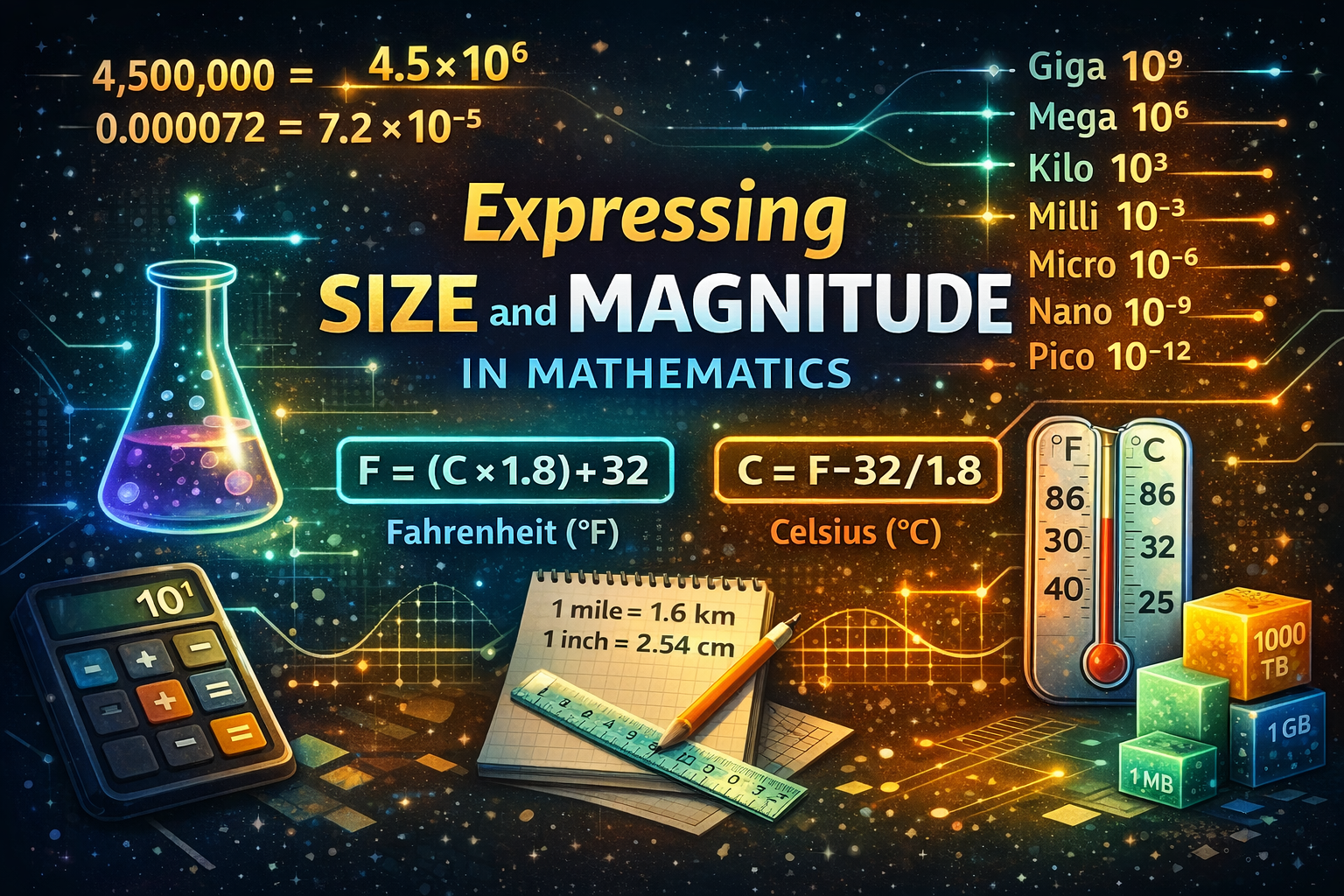
Introduction
In computer science, artificial intelligence, and data analytics, numbers can become extremely large or extremely small. For example:
- The number of parameters in deep learning models can reach billions.
- The probability of rare events may be very small numbers.
- Computer storage and data transfer use prefixes like kilobytes, gigabytes, and terabytes.
To work efficiently with such numbers, mathematics uses methods such as scientific notation, metric prefixes, and unit conversions. These tools allow engineers and AI developers to express quantities clearly and avoid calculation errors.
This lesson introduces methods for expressing size and magnitude, converting between measurement systems, and converting temperature units commonly used in computing environments.
4.1 Scientific Notation
Definition
Scientific notation is a way of writing very large or very small numbers using powers of 10.
A number in scientific notation has the form:
Where:
n = integer exponent
Why Scientific Notation Is Important in AI
Scientific notation is commonly used in:
- Machine learning probabilities
- Large datasets
- Computational complexity
- Hardware storage measurements
- Signal processing
For example:
| Number | Scientific Notation |
|---|---|
| 650000000 | 6.5 × 10^8 |
| 0.0000023 | 2.3 × 10^-6 |
| 34000000 | 3.4 × 10^7 |
Converting Large Numbers
Example 1
Convert:
Step 1: Move the decimal point
Step 2: Count moves
Result:
Example 2
Convert:
Solution:
Converting Small Numbers
Example 3
Convert:
Move decimal right until number is between 1 and 10.
Moves:
Result:
Example 4
Convert:
Solution:
4.2 Metric Prefixes (Giga to Pico)
In computing and science, metric prefixes represent powers of 10.
| Prefix | Symbol | Power of 10 | Example |
|---|---|---|---|
| Giga | G | 10^9 | Gigabyte |
| Mega | M | 10^6 | Megabyte |
| Kilo | k | 10^3 | Kilogram |
| Milli | m | 10^-3 | Millisecond |
| Micro | µ | 10^-6 | Microprocessor |
| Nano | n | 10^-9 | Nanotechnology |
| Pico | p | 10^-12 | Picosecond |
Example
Convert:
Since
Then:
Example
Convert:
Since:
Then:
4.3 SI Units vs Imperial Units
Two common measurement systems exist:
| Measurement | SI Units | Imperial Units |
|---|---|---|
| Length | meter (m) | inch, foot |
| Mass | kilogram (kg) | pound |
| Distance | kilometer (km) | mile |
| Volume | liter | gallon |
Common Conversions
| Imperial | SI Equivalent |
|---|---|
| 1 mile | 1.6 km |
| 1 inch | 2.54 cm |
| 1 foot | 0.3048 m |
Example
Convert:
Solution:
Example
Convert:
Solution:
4.4 Temperature Conversion
Temperature conversions are common in engineering, electronics, and environmental data analysis.
The two common scales are:
-
Celsius (°C)
-
Fahrenheit (°F)
Fahrenheit to Celsius Formula
Example
Convert:
Solution:
C = 54 / 1.8
C = 30°C
Celsius to Fahrenheit Formula
Example
Convert:
Solution:
F = 45 + 32
F = 77°F
Key Concepts to Remember
• Scientific notation simplifies very large and very small numbers.
• Metric prefixes represent powers of ten.
• Unit conversions are essential for scientific and engineering calculations.
• SI units are used globally in science and computing.
• Temperature conversions are important for physical computing systems and sensors.