
A Learning Management System (LMS) is a digital platform used by training providers to deliver learning content, manage learners, and keep training records in one place. In South Africa, an LMS has become increasingly important as institutions move away from paper-based systems toward structured, auditable digital learning environments.
For accredited training providers, an LMS is not just about online learning. It plays a practical role in learner tracking, evidence management, reporting readiness, and meeting the expectations of employers, SETAs, and quality councils.
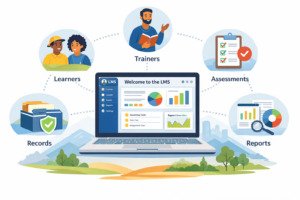
What an LMS actually is…
1. A central system for managing training
An LMS is a single platform where training providers manage courses, learners, assessments, and learning materials. Without a central system, information is often scattered across emails, spreadsheets, and folders, increasing the risk of errors and missing records.
2. A digital environment for learners
Learners use an LMS to access learning content, submit assessments, and track their progress. This creates a clear learning trail that can be reviewed if questions arise during internal reviews or external audits.
3. A record-keeping tool for compliance
In the South African context, training records matter long after a course ends. An LMS helps ensure learner data, assessments, and evidence are stored consistently, reducing reliance on manual filing systems that often fail during audits.
4. A support system for trainers and administrators
Trainers and administrators use an LMS to monitor progress, manage assessments, and identify learners who may be falling behind. Without this visibility, problems are often discovered too late, especially in large learner intakes.
5. A bridge between training and workplace learning
Many courses include practical or workplace-based components. An LMS can support the tracking of these activities, helping training providers maintain clearer oversight when learning extends beyond the classroom.
6. A safeguard against data loss
Manual systems are vulnerable to lost files, staff turnover, and inconsistent processes. An LMS reduces this risk by keeping structured records with defined access and history, which is critical when information is requested months or years later.
Why LMS platforms matter in South Africa
1. Growing pressure on training providers
Training providers are expected to produce accurate learner records, progress reports, and evidence when requested. An LMS helps institutions respond confidently instead of scrambling to reconstruct information.
2. Manual systems no longer scale
Spreadsheets and paper files may work for small groups, but they become unreliable as learner numbers grow. An LMS introduces consistency and reduces dependence on individual staff members’ personal systems.
4. Clearer accountability for learners and staff
An LMS creates transparency around who submitted what, when it was submitted, and how it was assessed. This accountability is difficult to achieve with email-based or paper-driven processes.
5. Better preparation for reviews and audits
When records are organised digitally, preparing for audits becomes a review exercise rather than a recovery exercise. This significantly lowers compliance risk for training institutions.
6. Alignment with digital transformation trends
South African skills development is steadily moving toward digital oversight and reporting. Training providers using LMS platforms are better positioned to adapt as expectations evolve.
Frequently asked questions
a. Is an LMS solely for online courses?
No. An LMS can support face-to-face, blended, and workplace-based learning by managing records, assessments, and learner progress, even when training is not fully online.
b. Do small training providers need an LMS?
Even small providers benefit from an LMS because learner records must often be retained for long periods. Digital systems reduce long-term risk regardless of institution size.
c. Can an LMS replace spreadsheets completely?
In most cases, yes. An LMS is designed specifically for training data, whereas spreadsheets are generic tools that lack audit trails, role controls, and structured evidence management.
d. Is an LMS the same as an LMIS?
No. An LMS focuses on learning delivery and learner management, while an LMIS focuses more broadly on verified learner records, reporting, and oversight. Some platforms, such as YibaWise, working alongside systems like Yiba Verified, are designed to support both learning and structured record management.
e. What happens if learner data is missing in an LMS?
Missing data is still a risk, but it is easier to identify and correct in an LMS because gaps are visible. In manual systems, missing records are often only discovered during audits.
Understanding LMS use beyond software
An LMS should be viewed as part of a training provider’s operational framework rather than just a technical tool. When implemented thoughtfully, it supports consistency, accountability, and long-term record integrity.
For South African training providers, the real value of an LMS lies in reducing administrative strain, improving learner oversight, and lowering compliance risk as skills development continues to evolve.