
Accountability is not about control or punishment. Instead, it is about clarity—knowing what is expected, what has been done, and what still needs attention. However, in training environments where responsibilities remain informal or undocumented, accountability quickly breaks down. A Learning Management System (LMS) helps training providers build a culture of accountability by making roles, actions, and outcomes visible and traceable.
For South African training providers, accountability supports fairness, consistency, and confidence across the organisation.
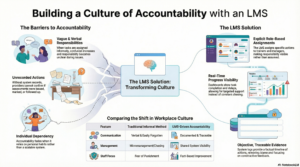
Why accountability is hard to maintain.
a. Responsibilities are implied, not defined
When staff assign tasks verbally or rely on assumptions, responsibility becomes unclear. Consequently, confusion increases, especially when issues arise.
b. Actions are not recorded
Without system records, providers struggle to confirm whether assessments were issued, marked, or followed up on time. As a result, accountability weakens.
c. Accountability depends on individuals
When systems rely on personal habits or memory, accountability fades as staff changes or workloads grow. Therefore, consistency suffers.
How an LMS supports accountability.
I. Clear role-based responsibilities
An LMS assigns actions to specific users—trainers, administrators, or managers. As a result, responsibility becomes explicit rather than assumed.
II. Visible task completion and delays
Activities such as assessment uploads, marking, feedback, and learner support remain visible. Consequently, everyone can see what is complete and what still needs attention.
III. Traceable actions and timelines
System records clearly show when tasks were completed and by whom. Therefore, accountability remains objective and non-confrontational.
Accountability without micromanagement.
-> Shared visibility instead of constant checking
When information is visible in the system, managers no longer need to chase updates or request frequent reports.
-> Objective conversations, not assumptions
Because discussions rely on system evidence, teams focus on facts rather than opinions or memory. As a result, conversations remain constructive.
-> Support where it is needed
When delays or gaps arise, staff can address them with targeted support rather than blame.
Why accountability matters in South Africa.
> Fairness for learners
Clear accountability ensures learners are assessed, supported, and certified consistently across programmes and intakes.
> Protection for staff
Documented actions protect trainers and administrators when questions or disputes arise.
> Stronger institutional credibility
Organisations that demonstrate accountability build trust with learners, employers, and stakeholders over time.
Common mistakes without an LMS.
– Relying on verbal agreements
Verbal accountability is easily misunderstood or forgotten, especially as workloads increase.
– Using accountability only when problems arise
Accountability works best when it forms part of everyday operations, not just crisis response.
– Confusing accountability with punishment
Fear-based approaches discourage transparency and prevent improvement.
Frequently asked questions.
1. Does accountability reduce trust?
No. In fact, clear accountability increases trust by removing uncertainty.
2. Can accountability exist without an LMS?
Yes. However, maintaining it consistently at scale becomes much harder.
3. Does accountability increase admin work?
No. It reduces follow-ups, misunderstandings, and repeated explanations.
4. Can accountability support performance improvement?
Yes. Visibility helps identify where support or change is needed.
5. Is accountability only for staff?
No. Learners also benefit from clear expectations and visibility into progress.
Accountability built through clarity
A culture of accountability develops when expectations are clear and actions remain visible. An LMS provides the structure needed to support this culture without creating pressure or micromanagement.
For South African training providers, using an LMS to build accountability strengthens operations, protects learners and staff, and supports reliable, professional training delivery.