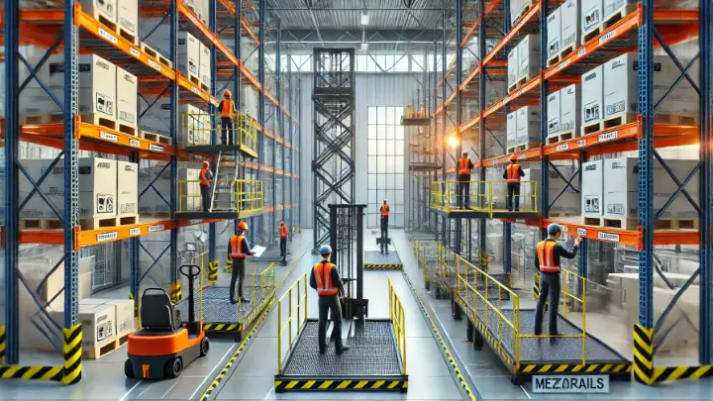
📘Lesson Summary:
This lesson explains the purpose of warehousing, the key processes involved in storing and handling products, the principles of facility layout, equipment usage, safety regulations, and the role of warehousing in supporting supply chain performance.
Lesson 1: Understanding Warehousing & Facility Operations (KM-05)
Warehousing is a critical component of the supply chain. It bridges production and consumption by safely storing goods until they are needed for order fulfilment. Proper warehousing ensures product availability, improves customer service, and supports efficient distribution.
Facility operations combine physical space, equipment, systems, and people to move products accurately and efficiently.
⭐ 1. Purpose of Warehousing
Warehouses play several key roles:
- Storage: Holding inventory until required.
- Buffering: Protecting against supply or demand variability.
- Consolidation: Combining products from different suppliers for bulk distribution.
- Break-bulk: Splitting large shipments into smaller ones for different destinations.
- Value-adding: Labelling, repacking, assembling, and quality checks.
Warehouses reduce lead time, support customer service, and stabilise supply chain flows.
⭐ 2. Core Warehouse Processes
Warehouse operations can be grouped into major workflows:
2.1 Receiving
- Offloading goods
- Verifying quantities and condition
- Checking documentation
- Updating inventory records
Incorrect receiving leads to stock inaccuracies.
2.2 Put-Away
Moving goods from receiving to their designated storage locations.
Good put-away:
- Reduces travel time
- Prevents damage
- Improves picking efficiency
2.3 Storage
Products may be stored as:
- Palletised goods
- Shelf stock
- Bulk stock
- Temperature-controlled items
Storage selection depends on:
- Product type
- Handling requirements
- Velocity of movement (fast/slow movers)
2.4 Picking
Retrieving items to fulfil customer or internal orders.
Picking methods include:
- Single-order picking
- Batch picking
- Zone picking
- Wave picking
Picking accuracy is the MOST important warehouse KPI.
2.5 Packing
Preparing items for safe transport:
- Wrapping
- Labelling
- Consolidation
- Sealing
2.6 Dispatch
Final stage before transport:
- Staging orders
- Loading vehicles
- Checking delivery documentation
Dispatch accuracy ensures correct orders reach customers.
⭐ 3. Warehouse Layout & Design
Effective warehouse layout aims to minimise travel distances and improve productivity.
Key layout elements:
- Receiving area
- Marshalling/staging area
- Storage zones
- Picking aisles
- Packing stations
- Dispatch zone
Layout must consider:
- Space utilisation
- Safety requirements
- Equipment movement
- Product velocity (ABC zoning)
Good facility design reduces congestion and speeds up operations.
⭐ 4. Material Handling Equipment (MHE)
Warehouses use various equipment to move, store, and handle goods:
- Forklifts
- Reach trucks
- Pallet jacks
- Conveyors
- Rollers
- Wrappers
- Stackers
Choosing the correct MHE ensures:
- Safe handling
- Reduced labour effort
- Faster operations
All MHE operators require proper training and licensing.
⭐ 5. Warehouse Health & Safety Requirements
Safety is essential to prevent injuries and protect inventory.
Key safety measures:
- PPE requirements
- Clearly marked walkways
- Speed limits for forklifts
- Fire safety systems
- Racking inspections
- Load capacity adherence
- Safe lifting techniques
- Chemical and hazardous goods compliance
Safety failures can lead to injuries, product damage, and legal liabilities.
⭐ 6. Inventory Accuracy in the Warehouse
Warehouse processes affect stock accuracy through:
- Miscounts
- Wrong-location storage
- Unrecorded movements
- Damaged goods
- Incorrect picks
Maintaining inventory accuracy involves:
- Cycle counting
- Regular audits
- Barcode scanning
- Proper documentation
Accurate inventory supports demand execution and customer service.
⭐ 7. Warehouse Technology Systems
Modern warehouses use technology such as:
- WMS (Warehouse Management Systems)
- Barcode scanners
- RFID
- Voice picking systems
- Automated storage & retrieval systems (AS/RS)
- Real-time dashboards
Technology improves accuracy, reduces human error, and enhances productivity.
⭐ 8. Warehousing KPIs
Common KPIs include:
- Picking accuracy
- Order cycle time
- Dock-to-stock time
- Inventory accuracy
- Space utilisation
- On-time dispatch rate
- Fill rate
KPIs help identify inefficiencies and drive performance improvement.
🎯 Lesson Outcomes
By the end of this lesson, learners will be able to:
- Explain the purpose of warehousing in the supply chain.
- Describe the core warehouse processes.
- Understand basic facility layout and design considerations.
- Identify common MHE used in warehouses.
- Apply warehouse safety principles.
- Evaluate inventory accuracy needs.
- Interpret key warehousing KPIs.
- Analyse warehouse operations in real-world scenarios.