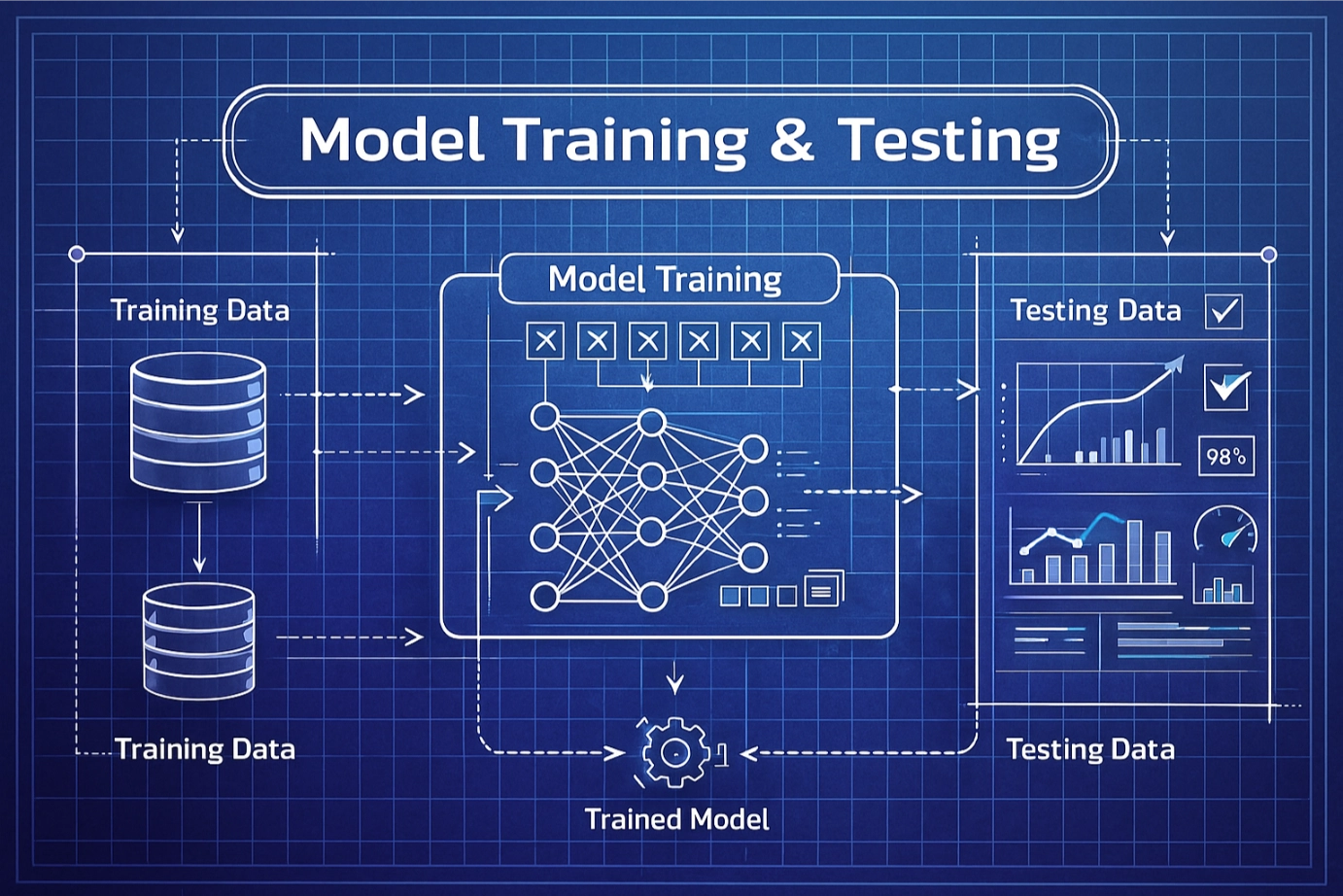
📘 Lesson Summary:
This lesson introduces the practical process of training machine learning models, adjusting parameters, testing performance, and improving accuracy. Learners will understand how models learn and how to evaluate their results.
Lesson 1: Model Training & Testing (PM-05)
Model training is the process where a machine learning algorithm learns patterns from data, while testing evaluates how well the model performs on unseen data. PM-05 focuses on helping learners build, train, test, and improve machine learning models in practical AI environments.
This lesson explains how training works, what performance metrics mean, and how to identify issues like overfitting and underfitting.
⭐ 1. Purpose of PM-05
PM-05 prepares learners to:
- Train machine learning models using prepared datasets
- Adjust hyperparameters to improve performance
- Evaluate model accuracy using test data
- Identify problems during training
- Document results and model behaviour
These are critical skills for AI developers in any industry.
⭐ 2. Key Concepts in Model Training
a) Hyperparameters
Settings that control how a model learns. Examples:
- Learning rate
- Number of epochs
- Batch size
- Maximum depth (for trees)
b) Epochs
One full pass of the training dataset through the model.
c) Loss Function
Shows how far off the model’s predictions are from the correct answers.
d) Optimization
Technique to reduce loss and improve learning.
⭐ 3. Key Concepts in Model Testing
a) Testing Dataset
Data never seen by the model during training.
b) Accuracy Score
Measures how often the model predicts correctly.
c) Confusion Matrix
Shows correct vs incorrect predictions in classification tasks.
d) Overfitting vs Underfitting
Overfitting: Model learns training data too well and performs poorly on new data.
Underfitting: Model is too simple and performs poorly on both training and testing data.
⭐ 4. Model Training Workflow (PM-05)
Learners work through a structured ML workflow:
- Prepare and split dataset
- Select algorithm
- Choose hyperparameters
- Train the model
- Evaluate performance
- Adjust and re-train
- Record results in logbook
This mirrors real workplace processes.
⭐ 5. Practical Activities in PM-05
Learners complete tasks such as:
- Training a classifier or regression model
- Adjusting hyperparameters
- Using metrics like accuracy or mean squared error
- Comparing different model results
- Documenting findings
These activities build hands-on machine learning experience.