Course Content
KM-01: Overview of Artificial Intelligence
This module introduces learners to the fundamental concepts of Artificial Intelligence (AI) and its growing role in modern technology, business, and society. Learners will explore the evolution of AI, key definitions, and different types of artificial intelligence, as well as related fields such as machine learning, deep learning, neural networks, data science, automation, and robotics. The module also examines how AI is applied in real-world environments, including industries such as healthcare, finance, agriculture, manufacturing, and digital services. In addition, learners will understand the strategic advantages of AI in business, including automation, improved decision-making, and increased productivity. By the end of the module, learners will have a foundational understanding of AI technologies, their applications, and their impact on the Fourth Industrial Revolution (4IR). This knowledge prepares learners for further study and practical skills development within the Artificial Intelligence Software Developer qualification at NQF Level 4.
0/8
KM-02: Introduction to Mathematics and Statistics for Artificial Intelligence
This module introduces learners to the essential mathematical and statistical concepts required for understanding Artificial Intelligence, Machine Learning, Deep Learning, and Data Analytics. It provides foundational knowledge in areas such as basic mathematics, linear algebra, binary number systems, scientific notation, probability, and statistics. Learners will explore how mathematical principles are used to represent data, perform calculations, and analyze patterns in AI systems. The module also develops problem-solving skills through practical applications including coordinate systems, matrix operations, and probability models used in modern AI technologies.
0/25
KM-03: Analytical Thinking and Problem Solving
This module focuses on developing the learner’s ability to analyse problems logically and design structured solutions. Learners are introduced to analytical thinking techniques, critical thinking skills, and problem-solving methods used in artificial intelligence development. The module teaches how to break down complex problems, evaluate possible solutions, and apply structured reasoning when designing AI-based systems. By the end of the module, learners will understand how to approach real-world problems systematically and use analytical tools such as decision trees and critical thinking methods to support AI problem solving
0/7
KM-04: Data, Databases and Data Visualisation
This module introduces learners to the fundamental concepts of data, database systems, and data visualisation, which are essential components in modern artificial intelligence and data-driven technologies. The module focuses on helping learners understand how data is collected, processed, analysed, stored, and transformed into meaningful insights for decision-making. Learners begin by exploring the value of data and the role of data analysis, including how reliable data sources are identified and how raw data is refined by handling missing values, correcting misalignments, and eliminating irrelevant information. The module also explains common flaws and limitations in data collection, such as bias, omission, and errors that may affect the quality and reliability of data. The module then moves into practical data handling using spreadsheets, where learners study techniques for analysing and presenting data. This includes creating reports, sorting and filtering datasets, using pivot tables and dashboards, importing data from files and databases, and visualising results using charts and analytical tools. Learners are also introduced to databases and Structured Query Language (SQL), which allow large volumes of data to be stored, managed, and retrieved efficiently. In addition, the module explores data mining techniques used to identify patterns and relationships within datasets. Finally, the module highlights the importance of data visualisation and data security, teaching learners how to present information clearly using AI-assisted tools while ensuring that sensitive information is protected from misuse or unauthorized access. Overall, this module equips learners with the knowledge required to manage data effectively, perform analysis, create meaningful visualisations, and maintain data integrity and security, which are critical skills for professionals working in artificial intelligence, data science, and software development environments.
0/17
KM-05: Computing Theory
computational thinking. Programming is the process of writing instructions that tell a computer how to perform tasks. These instructions are written using programming languages such as Python, Java, or C++. In this module learners will develop an understanding of how computers interpret instructions, how algorithms are used to solve problems, and how basic programming structures work. The module also introduces the core principles of software development and provides an entry-level understanding of Python programming. By the end of the module learners will understand how software systems are designed, how algorithms are created to solve problems, and how programming languages are used to build modern digital solutions including artificial intelligence systems. The module covers the following key topics: Introduction to programming languages Introduction to algorithms Programming basics Solution development Introduction to Python These concepts provide the theoretical foundation needed before learners begin writing real programs in practical learning modules.
0/11
KM-06: Introduction to Artificial Intelligence, Machine Learning, Deep Learning
The main focus of the learning in this knowledge module is to build an understanding of the relationship between Artificial Intelligence, Machine Learning and Deep Learning, as well as the application of such systems to create a set of instructions to perform a programming task. Learners will explore how AI technologies are used across industries such as healthcare, finance, education, and automation. The module also introduces ethical considerations, responsible AI use, and the impact of AI on society and employment. By the end of this module, learners will understand how artificial intelligence systems work, the different types of AI technologies, and how these technologies are applied in modern software development environments.
0/3
KM-07: Artificial Intelligence Frameworks and Data Scraping
This module introduces learners to Artificial Intelligence frameworks and their role in developing intelligent systems. Learners will explore how frameworks such as TensorFlow, Keras, PyTorch and IBM Watson help developers design, train and deploy AI models efficiently. The module also introduces the concept of data scraping, explaining how AI technologies can be used to collect and extract information from websites. Learners will understand the tools, procedures, and legal considerations involved in web scraping and how this data can be used for analytics and decision-making. By the end of the module, learners will understand the structure of AI frameworks, their advantages, practical applications, and how AI techniques can be used to automate data extraction processes.
0/7
KM-08: Machine learning
The main focus of this knowledge module is to build an understanding of the relationship between Artificial Intelligence (AI), Machine Learning (ML), and Deep Learning, as well as the application of machine learning to create a set of instructions that can perform programming tasks. This module introduces learners to the types of machine learning models, machine learning algorithm classifications, common machine learning algorithms, and the machine learning workflow process used to develop intelligent systems. Learners will also explore how machine learning can support business decision-making and improve business performance. The module further explains how machine learning systems use data, features, and labels to identify patterns, make predictions, and automate tasks. By understanding these concepts, learners will gain the foundational knowledge required to work with machine learning technologies and apply them in real-world applications and business environments.
0/11
KM-09: Deep Learning (DL)
This module introduces learners to the concept of Deep Learning, an advanced area of Artificial Intelligence that builds on Machine Learning techniques to create intelligent systems capable of learning complex patterns from large datasets. The module focuses on understanding the relationship between Artificial Intelligence (AI), Machine Learning (ML), and Deep Learning (DL) and how deep learning technologies are used to develop intelligent applications. Learners will explore how neural networks are structured and how they function, including the roles of input layers, hidden layers, and output layers in deep learning systems. The module also introduces different neural network architectures such as convolutional neural networks, recurrent neural networks, and recursive neural networks, which are widely used in fields such as computer vision, natural language processing, and speech recognition. In addition, the module covers activation functions used in deep learning models, including functions such as Sigmoid, Tanh, Softmax, and ReLU. Learners will also study how deep learning networks are built, trained, and tuned to improve performance. These concepts help developers design more accurate and efficient models for solving complex computational problems. The module further introduces advanced Python concepts for deep learning, including decorators, context managers, exception handling, and Python package management. These programming techniques are important for developing scalable deep learning applications. Finally, learners will explore TensorFlow and Keras, two of the most widely used frameworks for deep learning development. These tools allow developers to build, train, and deploy neural networks efficiently using modern machine learning libraries and APIs. By the end of this module, learners will understand the core concepts of deep learning, neural network architecture, advanced Python programming for AI development, and the use of TensorFlow and Keras to build deep learning models.
0/7
KM-10: Introduction to Governance, Legislation and Ethics
This module introduces learners to the principles of governance, legislation, ethics, workplace security, and business practices that influence organisations and employees. The module focuses on understanding how legal frameworks and ethical standards guide behaviour in the workplace and ensure accountability, transparency, and responsible decision-making. Learners will explore important workplace legislation such as the Labour Relations Act (LRA), the Protection of Personal Information Act (POPIA), and other regulatory frameworks that affect employees and employers. The module also introduces key ethical principles, including professional conduct, fairness, honesty, and accountability in professional environments. In addition, the module examines workplace security, performance management, business planning, and costing concepts that influence organisational efficiency and sustainability. By the end of the module, learners will understand how governance, ethics, legislation, and management practices contribute to a responsible and productive workplace environment.
0/19
KM-11: Fundamentals of Design Thinking and Innovation
This module introduces learners to the principles of design thinking, creativity, and innovation in the workplace. It focuses on solving problems using a human-centered approach, where user needs are prioritised through observation, empathy, and iterative development. Learners will explore key concepts such as design thinking methodology, creativity, innovation types, and application in real-world environments, including software development and business. The module also highlights how organisations use design thinking to improve products, processes, and services while fostering innovation. By the end of this module, learners will understand how to apply design thinking to solve complex problems and drive innovation effectively in the workplace.
0/15
KM-12: Fundamentals of Research and Information Analysis
This module focuses on developing an understanding of research principles, information gathering, and data analysis techniques. It equips learners with the ability to collect, evaluate, interpret, and apply information effectively in problem-solving and decision-making contexts
0/6
Artificial Intelligence Software Developer

Lesson Overview

In mathematics, statistics, programming, and artificial intelligence, calculations must be done carefully. A small mistake in one step can affect the final answer. Sometimes the error comes from misunderstanding the type of number being used. Sometimes it comes from rounding too early. Sometimes it comes from using a formula correctly but interpreting the result poorly.

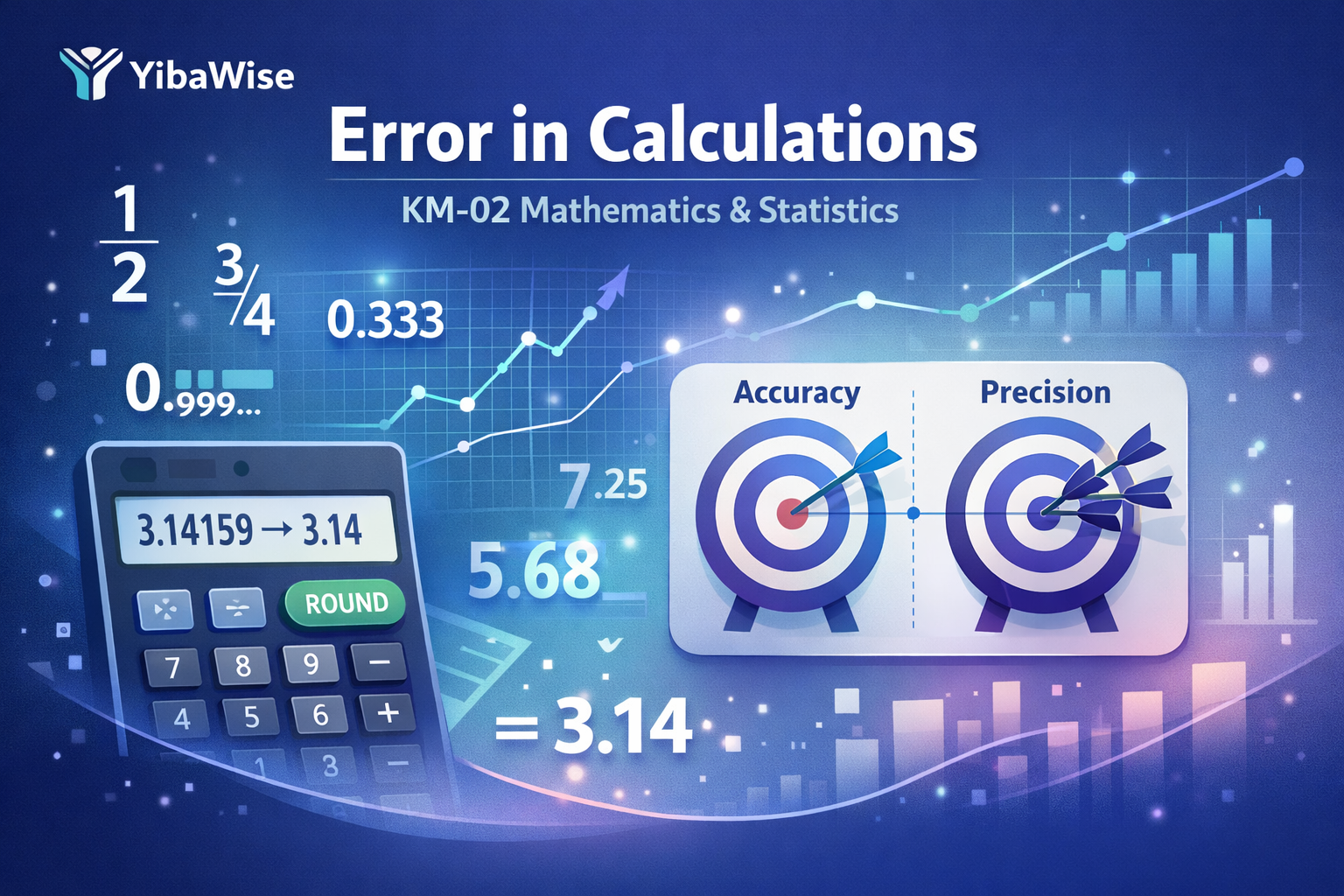
This lesson helps learners understand what calculation errors are, how they happen, and how to reduce them. The lesson also introduces rational and irrational numbers, rounding rules, and the difference between accuracy and precision, because all of these ideas affect how we work with data and mathematical results. The module source specifically places these topics under KM-02-KT05: Error in calculations.   

Learning Outcomes

By the end of this lesson, learners should be able to:

  • explain what a calculation error means
  • distinguish between rational and irrational numbers
  • explain what a rounding error is
  • apply standard rounding rules correctly
  • explain the difference between accuracy and precision
  • understand why careless calculation affects statistics, programming, and AI results

1. What is an error in calculations?

An error in calculations is the difference between the correct value and the value obtained after a mistake, approximation, or limitation in the calculation process.

This does not always mean someone did “bad maths.” Sometimes the error happens because:

  • A number was rounded
  • Too few decimal places were used
  • a calculator or computer stored an approximation
  • The wrong order of operations was followed
  • A formula was applied incorrectly
  • A value was measured imprecisely

Simple example

Suppose the actual value is:

3.14159265

But you write:

3.14

That is not completely wrong, but it is less exact. The gap between the actual value and the rounded value is an error caused by approximation.

Why this matters

In everyday maths, a small error may not seem serious. But in:

  • engineering
  • finance
  • data analysis
  • machine learning
  • software development

small errors can grow into bigger ones.

A tiny error repeated thousands of times can become a very real problem. That’s maths being dramatic, but for good reason.

2. Rational and irrational numbers

The source material for this section explains that a rational number is a number that can be written as a fraction p/q, where p and q are integers and q \neq 0. It also explains that irrational numbers cannot be written as a simple fraction and have decimal expansions that do not terminate and do not repeat.   

2.1 Rational numbers

A rational number is any number that can be expressed as a fraction of two integers.

General form

\frac{p}{q}, \quad q \neq 0

Where:

  • p is an integer
  • q is an integer
  • q is not zero

Examples of rational numbers

  • \frac{1}{2}
  • \frac{3}{4}
  • -\frac{5}{2}
  • 6, because 6 = \frac{6}{1}
  • 0.75, because 0.75 = \frac{3}{4}
  • 0.333…, because repeating decimals can be expressed as fractions

Important idea

A rational number may appear as:

  • a whole number
  • a fraction
  • a terminating decimal
  • a repeating decimal

Example

0.5 = \frac{1}{2}

0.777777… = \frac{7}{9}

So even if a number is written as a decimal, it can still be rational.

2.2 Irrational numbers

An irrational number is a number that cannot be written as a fraction of two integers.

These numbers:

  • never end
  • never repeat in a fixed pattern

Examples of irrational numbers

  • \pi = 3.14159265…
  • \sqrt{2} = 1.41421356…
  • e = 2.7182818…


2.3 Why this matters in calculations

Knowing whether a number is rational or irrational matters because irrational numbers are often approximated.

For example:

\pi \approx 3.14

or

\sqrt{2} \approx 1.41

These approximations make calculations easier, but they also introduce error.

Example

Find the circumference of a circle with radius 7:

C = 2\pi r

Using \pi = 3.14:

C = 2(3.14)(7) = 43.96

Using a more exact value of \pi:

C \approx 43.9823

The answers are close, but not identical. That small difference is an approximation error.

3. Repeating decimals and calculation accuracy

The learner guide also discusses repeating decimals and shows that increasing the number of digits can improve accuracy, but still may not produce an exact value if the number goes on forever. 

A repeating decimal like:

0.333333…

is rational, because it can be written as:

\frac{1}{3}

But when a computer stores it as:

0.3333

or

0.333333

it is using an approximation.

Example

\frac{1}{3} + \frac{1}{3} + \frac{1}{3} = 1

But if we use rounded decimals:

0.33 + 0.33 + 0.33 = 0.99

Now the answer is slightly wrong.

That is a great example of how rounding can create error, even when the original maths is perfect.

4. What is rounding error?

The source material defines rounding error as the difference between a rounded-off numerical value and the actual value. 

A rounding error happens when a number is shortened to fewer decimal places or significant figures.

Example 1

Actual value:

5.6789

Rounded to 2 decimal places:

5.68

Rounding error:

5.6789 – 5.68 = -0.0011

The rounded result is close, but not exact.

Example 2

Suppose a machine records a weight as:

12.486 kg

If a report rounds it to:

12.5 kg

the rounded number is easier to read, but the exact value is lost.

4.1 Why rounding is used

Rounding is useful because it:

  • makes numbers easier to read
  • simplifies reports
  • reduces the amount of memory used by computers
  • helps communicate results clearly

But rounding must be used carefully.

If rounding is done too early in a long calculation, the final answer may become inaccurate.

4.2 Premature rounding

Premature rounding means rounding before the final answer is reached.

That is a common source of avoidable error.

Example

Calculate:

(2.36 \times 4.81)

Exact multiplication:

2.36 \times 4.81 = 11.3516

If we round too early:

  • 2.36 becomes 2.4
  • 4.81 becomes 4.8

Then:

2.4 \times 4.8 = 11.52

Now compare:

  • more exact answer: 11.3516
  • rounded-too-early answer: 11.52

That difference may seem small, but it can matter a lot in science, finance, or AI training data.

Best practice

Keep as many digits as possible during the working steps, then round at the end.

5. Rounding rules for statistical calculations

The source material says that with traditional rounding, if the number after the chosen place is less than halfway, round down, and if it is exactly halfway or greater, round up. 

Standard rounding rule

When rounding a number:

  • if the next digit is 0, 1, 2, 3, or 4, round down
  • if the next digit is 5, 6, 7, 8, or 9, round up

Examples

Round 3.42 to 1 decimal place

The second decimal digit is 2, so round down:

3.42 \approx 3.4

Round 8.67 to 1 decimal place

The second decimal digit is 7, so round up:

8.67 \approx 8.7

Round 15.5 to the nearest whole number

The decimal part is 5, so round up:

15.5 \approx 16

5.1 Statistical example

Suppose the average score of a class is:

72.46

Rounded to one decimal place:

72.5

Rounded to the nearest whole number:

72

Different rounding levels can change how results are presented, so it is important to know what level of precision is required.

6. Accuracy and precision

The source material explains that accuracy is how close a measurement is to the true value, while precision is how reproducible or consistent measurements are. 

These are not the same thing.

6.1 Accuracy

Accuracy means closeness to the true or accepted value.

Example

If the correct length of an object is 10 cm, and you measure:

9.99 cm

that result is very accurate.

6.2 Precision

Precision means consistency. If you repeat a measurement several times and get almost the same answer each time, the measurements are precise.

Example

You measure the same object four times and get:

  • 8.2 cm
  • 8.2 cm
  • 8.3 cm
  • 8.2 cm

These results are precise because they are close to one another.

But if the actual length is 10 cm, they are not accurate.

7. Error caused by wrong order of operations

The learner guide also notes that PEMDAS helps, but can fail when people apply it too literally or misunderstand how an expression is written. 

Example

Evaluate:

1 + (6 – 4)^3

Correct steps:

  1. Brackets: 6 – 4 = 2
  2. Exponent: 2^3 = 8
  3. Add: 1 + 8 = 9

Correct answer:

9

If someone ignores the order of operations, they may get the wrong answer.

This kind of error is not a rounding error. It is a procedure error.

7.1 Why PEMDAS can still confuse people

Expressions like:

6 \div 2(1+2)

often cause arguments because people read them differently. The source material warns that these kinds of expressions can be misleading and are often badly written in the first place. 

Lesson point

Good mathematics is not only about calculation. It is also about writing expressions clearly.

When writing formulas for learners or systems:

  • use brackets properly
  • avoid ambiguous notation
  • make the intended grouping obvious

8. Error in computing and AI

This lesson belongs to a module that prepares learners to understand mathematics and statistics for AI, machine learning, deep learning, and data analytics. 

So let’s connect the lesson to AI directly.

8.1 Computers do not always store exact decimals

Some decimals cannot be stored exactly in binary form.

For example:

  • 0.1 may not be stored exactly as 0.1
  • it may be stored as a very close approximation

That can lead to surprising results in programming.

Example

A programmer may expect:

0.1 + 0.2 = 0.3

But in some systems, the answer may display as:

0.30000000000000004

That happens because of how numbers are represented internally.

8.2 Why this matters in machine learning

Machine learning models depend on calculations such as:

  • averages
  • distances
  • probabilities
  • gradients
  • loss values

If values are rounded badly, scaled badly, or measured badly, the model can produce weaker predictions.

Example

Imagine training a model using ages:

  • 21.8
  • 21.9
  • 22.1
  • 22.0

If all values are roughly rounded to:

  • 22
  • 22
  • 22
  • 22

the model loses detail.

That lost detail may reduce the model’s ability to learn patterns correctly.

9. Worked examples

Example 1: Rational or irrational?

Classify each number:

a) \frac{7}{8}

b) 0.125

c) \sqrt{3}

d) 5

Solution

  • \frac{7}{8}: rational
  • 0.125: rational, because it can be written as \frac{1}{8}
  • \sqrt{3}: irrational
  • 5: rational, because 5 = \frac{5}{1}

Example 2: Rounding correctly

Round 12.476 to:

  • 1 decimal place
  • 2 decimal places

Solution

To 1 decimal place:

  • look at the second decimal digit: 7
  • round up

12.476 \approx 12.5

To 2 decimal places:

  • look at the third decimal digit: 6
  • round up

12.476 \approx 12.48

Example 3: Accuracy and precision

A scale should read 50.0 kg.

Readings taken:

  • 49.9
  • 49.9
  • 49.8
  • 49.9

Discussion

These readings are:

  • precise, because they are very close to each other
  • also fairly accurate, because they are close to 50.0 kg
  • Example 4: Premature rounding

Find:

\frac{10}{3}

Exact form:

3.333333…

If rounded too early to 3.3, then multiplied by 3:

3.3 \times 3 = 9.9

But the true exact relationship is:

\frac{10}{3} \times 3 = 10

That shows how early rounding creates an error.

10. Key lesson summary

In this lesson, learners studied error in calculations and saw that errors can happen for different reasons. Some errors come from approximating irrational numbers. Others come from rounding too early, misunderstanding number types, or applying mathematical rules carelessly. The source documents for KM-02 specifically include rational numbers, rounding error, rounding rules, and the difference between accuracy and precision as part of this topic.     

Main ideas to remember

  • Rational numbers can be written as fractions.
  • Irrational numbers cannot be written as simple fractions.
  • Rounding error is the difference between the rounded value and the actual value.
  • Round only when necessary, preferably at the end.
  • Accuracy means closeness to the true value.
  • Precision means consistency of repeated results.
  • Small errors in maths can become big problems in computing, statistics, and AI.
  • 11. Short activity for learners

Ask learners to do the following:

Activity A: Classify the numbers

Identify whether each number is rational or irrational:

  • 0.75

  • \pi

  • \sqrt{16}

  • \sqrt{5}

  • 2.222…

Activity B: Round correctly

Round these values:

  • 6.284 to 2 decimal places
  • 15.95 to 1 decimal place
  • 101.444 to 2 decimal places

Activity C: Accuracy or precision

A measuring tool gives these results for a true value of 20 cm:

  • 18.1, 18.1, 18.2, 18.1

Ask:

  • Is it precise?
  • Is it accurate?
  • Why?
Scroll to Top