Course Content
KM-01: Overview of Artificial Intelligence
This module introduces learners to the fundamental concepts of Artificial Intelligence (AI) and its growing role in modern technology, business, and society. Learners will explore the evolution of AI, key definitions, and different types of artificial intelligence, as well as related fields such as machine learning, deep learning, neural networks, data science, automation, and robotics. The module also examines how AI is applied in real-world environments, including industries such as healthcare, finance, agriculture, manufacturing, and digital services. In addition, learners will understand the strategic advantages of AI in business, including automation, improved decision-making, and increased productivity. By the end of the module, learners will have a foundational understanding of AI technologies, their applications, and their impact on the Fourth Industrial Revolution (4IR). This knowledge prepares learners for further study and practical skills development within the Artificial Intelligence Software Developer qualification at NQF Level 4.
0/8
KM-02: Introduction to Mathematics and Statistics for Artificial Intelligence
This module introduces learners to the essential mathematical and statistical concepts required for understanding Artificial Intelligence, Machine Learning, Deep Learning, and Data Analytics. It provides foundational knowledge in areas such as basic mathematics, linear algebra, binary number systems, scientific notation, probability, and statistics. Learners will explore how mathematical principles are used to represent data, perform calculations, and analyze patterns in AI systems. The module also develops problem-solving skills through practical applications including coordinate systems, matrix operations, and probability models used in modern AI technologies.
0/25
KM-03: Analytical Thinking and Problem Solving
This module focuses on developing the learner’s ability to analyse problems logically and design structured solutions. Learners are introduced to analytical thinking techniques, critical thinking skills, and problem-solving methods used in artificial intelligence development. The module teaches how to break down complex problems, evaluate possible solutions, and apply structured reasoning when designing AI-based systems. By the end of the module, learners will understand how to approach real-world problems systematically and use analytical tools such as decision trees and critical thinking methods to support AI problem solving
0/7
KM-04: Data, Databases and Data Visualisation
This module introduces learners to the fundamental concepts of data, database systems, and data visualisation, which are essential components in modern artificial intelligence and data-driven technologies. The module focuses on helping learners understand how data is collected, processed, analysed, stored, and transformed into meaningful insights for decision-making. Learners begin by exploring the value of data and the role of data analysis, including how reliable data sources are identified and how raw data is refined by handling missing values, correcting misalignments, and eliminating irrelevant information. The module also explains common flaws and limitations in data collection, such as bias, omission, and errors that may affect the quality and reliability of data. The module then moves into practical data handling using spreadsheets, where learners study techniques for analysing and presenting data. This includes creating reports, sorting and filtering datasets, using pivot tables and dashboards, importing data from files and databases, and visualising results using charts and analytical tools. Learners are also introduced to databases and Structured Query Language (SQL), which allow large volumes of data to be stored, managed, and retrieved efficiently. In addition, the module explores data mining techniques used to identify patterns and relationships within datasets. Finally, the module highlights the importance of data visualisation and data security, teaching learners how to present information clearly using AI-assisted tools while ensuring that sensitive information is protected from misuse or unauthorized access. Overall, this module equips learners with the knowledge required to manage data effectively, perform analysis, create meaningful visualisations, and maintain data integrity and security, which are critical skills for professionals working in artificial intelligence, data science, and software development environments.
0/17
KM-05: Computing Theory
computational thinking. Programming is the process of writing instructions that tell a computer how to perform tasks. These instructions are written using programming languages such as Python, Java, or C++. In this module learners will develop an understanding of how computers interpret instructions, how algorithms are used to solve problems, and how basic programming structures work. The module also introduces the core principles of software development and provides an entry-level understanding of Python programming. By the end of the module learners will understand how software systems are designed, how algorithms are created to solve problems, and how programming languages are used to build modern digital solutions including artificial intelligence systems. The module covers the following key topics: Introduction to programming languages Introduction to algorithms Programming basics Solution development Introduction to Python These concepts provide the theoretical foundation needed before learners begin writing real programs in practical learning modules.
0/11
KM-06: Introduction to Artificial Intelligence, Machine Learning, Deep Learning
The main focus of the learning in this knowledge module is to build an understanding of the relationship between Artificial Intelligence, Machine Learning and Deep Learning, as well as the application of such systems to create a set of instructions to perform a programming task. Learners will explore how AI technologies are used across industries such as healthcare, finance, education, and automation. The module also introduces ethical considerations, responsible AI use, and the impact of AI on society and employment. By the end of this module, learners will understand how artificial intelligence systems work, the different types of AI technologies, and how these technologies are applied in modern software development environments.
0/3
KM-07: Artificial Intelligence Frameworks and Data Scraping
This module introduces learners to Artificial Intelligence frameworks and their role in developing intelligent systems. Learners will explore how frameworks such as TensorFlow, Keras, PyTorch and IBM Watson help developers design, train and deploy AI models efficiently. The module also introduces the concept of data scraping, explaining how AI technologies can be used to collect and extract information from websites. Learners will understand the tools, procedures, and legal considerations involved in web scraping and how this data can be used for analytics and decision-making. By the end of the module, learners will understand the structure of AI frameworks, their advantages, practical applications, and how AI techniques can be used to automate data extraction processes.
0/7
KM-08: Machine learning
The main focus of this knowledge module is to build an understanding of the relationship between Artificial Intelligence (AI), Machine Learning (ML), and Deep Learning, as well as the application of machine learning to create a set of instructions that can perform programming tasks. This module introduces learners to the types of machine learning models, machine learning algorithm classifications, common machine learning algorithms, and the machine learning workflow process used to develop intelligent systems. Learners will also explore how machine learning can support business decision-making and improve business performance. The module further explains how machine learning systems use data, features, and labels to identify patterns, make predictions, and automate tasks. By understanding these concepts, learners will gain the foundational knowledge required to work with machine learning technologies and apply them in real-world applications and business environments.
0/11
KM-09: Deep Learning (DL)
This module introduces learners to the concept of Deep Learning, an advanced area of Artificial Intelligence that builds on Machine Learning techniques to create intelligent systems capable of learning complex patterns from large datasets. The module focuses on understanding the relationship between Artificial Intelligence (AI), Machine Learning (ML), and Deep Learning (DL) and how deep learning technologies are used to develop intelligent applications. Learners will explore how neural networks are structured and how they function, including the roles of input layers, hidden layers, and output layers in deep learning systems. The module also introduces different neural network architectures such as convolutional neural networks, recurrent neural networks, and recursive neural networks, which are widely used in fields such as computer vision, natural language processing, and speech recognition. In addition, the module covers activation functions used in deep learning models, including functions such as Sigmoid, Tanh, Softmax, and ReLU. Learners will also study how deep learning networks are built, trained, and tuned to improve performance. These concepts help developers design more accurate and efficient models for solving complex computational problems. The module further introduces advanced Python concepts for deep learning, including decorators, context managers, exception handling, and Python package management. These programming techniques are important for developing scalable deep learning applications. Finally, learners will explore TensorFlow and Keras, two of the most widely used frameworks for deep learning development. These tools allow developers to build, train, and deploy neural networks efficiently using modern machine learning libraries and APIs. By the end of this module, learners will understand the core concepts of deep learning, neural network architecture, advanced Python programming for AI development, and the use of TensorFlow and Keras to build deep learning models.
0/7
KM-10: Introduction to Governance, Legislation and Ethics
This module introduces learners to the principles of governance, legislation, ethics, workplace security, and business practices that influence organisations and employees. The module focuses on understanding how legal frameworks and ethical standards guide behaviour in the workplace and ensure accountability, transparency, and responsible decision-making. Learners will explore important workplace legislation such as the Labour Relations Act (LRA), the Protection of Personal Information Act (POPIA), and other regulatory frameworks that affect employees and employers. The module also introduces key ethical principles, including professional conduct, fairness, honesty, and accountability in professional environments. In addition, the module examines workplace security, performance management, business planning, and costing concepts that influence organisational efficiency and sustainability. By the end of the module, learners will understand how governance, ethics, legislation, and management practices contribute to a responsible and productive workplace environment.
0/19
KM-11: Fundamentals of Design Thinking and Innovation
This module introduces learners to the principles of design thinking, creativity, and innovation in the workplace. It focuses on solving problems using a human-centered approach, where user needs are prioritised through observation, empathy, and iterative development. Learners will explore key concepts such as design thinking methodology, creativity, innovation types, and application in real-world environments, including software development and business. The module also highlights how organisations use design thinking to improve products, processes, and services while fostering innovation. By the end of this module, learners will understand how to apply design thinking to solve complex problems and drive innovation effectively in the workplace.
0/15
KM-12: Fundamentals of Research and Information Analysis
This module focuses on developing an understanding of research principles, information gathering, and data analysis techniques. It equips learners with the ability to collect, evaluate, interpret, and apply information effectively in problem-solving and decision-making contexts
0/6
Artificial Intelligence Software Developer

Lesson Overview

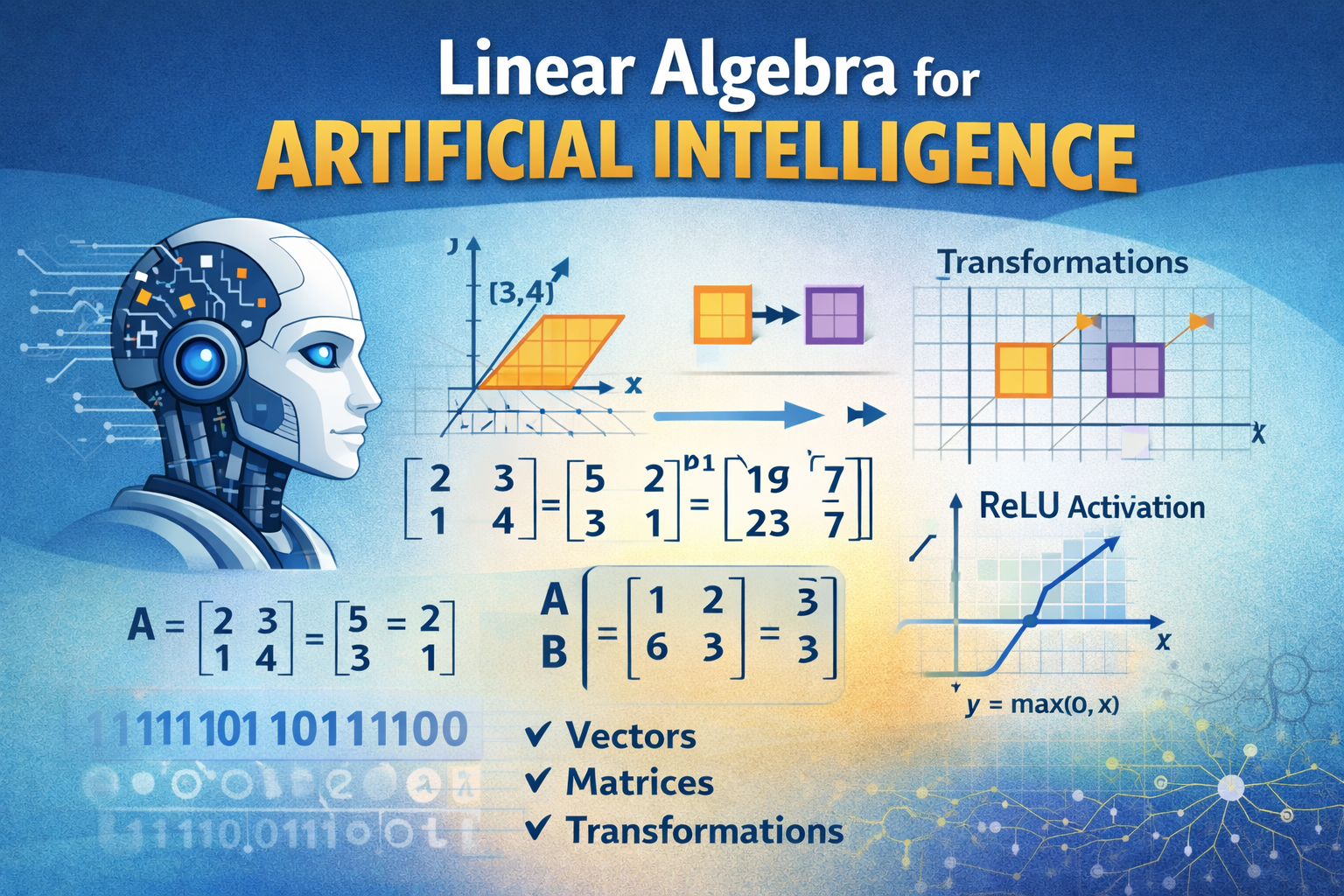
Linear algebra is one of the most important mathematical foundations used in Artificial Intelligence, Machine Learning, and Deep Learning. Many AI systems rely on mathematical structures such as vectors, matrices, and linear transformations to represent data and perform complex computations. These concepts allow machines to process large amounts of information efficiently and identify patterns within datasets.

In AI applications, linear algebra helps computers perform operations such as image recognition, speech processing, recommendation systems, and predictive modelling. Neural networks, which are the backbone of modern AI systems, rely heavily on matrix multiplication and vector calculations to process data and adjust model parameters during training.

1. What is Linear Algebra?

Linear algebra is a branch of mathematics that focuses on vectors, matrices, and linear transformations. These mathematical structures help represent and manipulate data in multi-dimensional spaces.

In artificial intelligence, linear algebra is used to:

  • Represent datasets as numerical structures
  • Transform data for machine learning models
  • Perform calculations in neural networks
  • Optimize algorithms used in AI systems

Because AI systems process large datasets, linear algebra provides the mathematical tools needed to perform efficient calculations.

2. Vectors

A vector is a mathematical object that has both magnitude (size) and direction. Geometrically, vectors can be represented as arrows pointing from one point to another.

For example:

v = (3, 4)

This vector represents movement of 3 units along the x-axis and 4 units along the y-axis.

Vectors are widely used in AI to represent:

  • Data points in machine learning
  • Word representations in natural language processing
  • Pixel values in images
  • Feature sets in datasets

Each data point in a machine learning model can be represented as a vector containing several values.

3. Matrices

A matrix is a rectangular arrangement of numbers organized into rows and columns.

Example matrix:

| 2 3 |
| 1 4 |

Matrices are extremely important in AI because they allow computers to process large amounts of data simultaneously. Many operations in machine learning involve multiplying matrices together to transform data.

Matrices are used in AI for:

  • Storing datasets
  • Performing transformations
  • Calculating neural network outputs
  • Image processing operations

There are several types of matrices including:

  • Row matrix
  • Column matrix
  • Square matrix
  • Diagonal matrix
  • Symmetric matrix

These different matrix types are used depending on the mathematical problem being solved.

4. Matrix Operations

Matrix operations allow mathematical manipulation of matrices. Some of the most common matrix operations include:

Matrix Addition

Two matrices can be added if they have the same dimensions.

Example:

A = |1 2|
  |3 4|

B = |5 6|
  |7 8|

A + B = |6 8|
    |10 12|

Matrix Multiplication

Matrix multiplication is one of the most important operations in AI systems.

If matrix A is multiplied by matrix B, the resulting matrix is obtained by multiplying rows by columns.

Matrix multiplication is used extensively in neural networks, where inputs are multiplied by weight matrices to generate predictions.

5. Linear Transformations

A linear transformation is a mathematical operation that transforms vectors while preserving the structure of the data.

A transformation can change:

  • Scale
  • Rotation
  • Direction
  • Position

Linear transformations are important in AI because they allow machine learning models to convert raw data into useful representations for learning patterns.

For example:

A transformation function may convert image pixel values into features that help an AI system recognize objects.

6. Activation Functions and ReLU

In deep learning, linear algebra operations are often combined with activation functions.

One common activation function is ReLU (Rectified Linear Unit).

ReLU works as follows:

  • If the input value is positive → return the value
  • If the input value is negative → return 0

This function helps neural networks learn complex patterns and improves training efficiency.

7. Importance of Linear Algebra in AI

Linear algebra is essential in AI because it allows systems to process high-dimensional data efficiently. Some key areas where linear algebra is used include:

  • Neural networks
  • Machine learning algorithms
  • Computer vision
  • Natural language processing
  • Data analytics

Without linear algebra, it would be extremely difficult for computers to process the large datasets required for modern AI systems.

1. Extended Examples: Basic Mathematics in AI

Example 1: Operator Precedence in Programming

Expression:

8+4×328 + 4 \times 3^2

Using PEMDAS/BODMAS:

  1. Exponent → 32=93^2 = 9

  2. Multiplication → 4×9=364 × 9 = 36

  3. Addition → 8+36=448 + 36 = 44

Final Answer:

4444

Example 2: Integer Division in Programming

In Python or C-style languages:

 
15 // 4
 

Result:

15÷4=315 ÷ 4 = 3

The decimal part is discarded.

Real AI example:

When dividing a dataset into batches of training data, integer division determines how many full batches exist.

Example 3: Modulus in Real Applications

Example:

17mod  517 \mod 5

Step:

17 ÷ 5 = 3 remainder 2

Result:

17mod  5=217 \mod 5 = 2

AI Application:

The modulus operator is used for:

  • cyclic operations
  • hashing functions
  • alternating training samples

Example:

 
if (index % 2 == 0)
 

Used to process even indexed data samples.

2. Extended Examples: Linear Algebra in AI

Linear algebra is the foundation of machine learning models.

Example 1: Vector Representation in Machine Learning

A dataset representing a house:

Feature Value
Bedrooms 3
Bathrooms 2
Size (m²) 150

Vector representation:

v=[3,2,150]v = [3,2,150]

AI uses vectors like this to train models.

Example 2: Matrix Representation

Suppose 3 houses:

X=[32150432002190]X = \begin{bmatrix} 3 & 2 & 150 \\ 4 & 3 & 200 \\ 2 & 1 & 90 \end{bmatrix}

Each row = observation
Each column = feature

Machine learning algorithms operate on matrices like this.

Example 3: Linear Transformation

Matrix transformation:

T(x,y)=[2002]T(x,y) = \begin{bmatrix} 2 & 0 \\ 0 & 2 \end{bmatrix}

Applied to vector:

(3,4)(3,4)

Result:

(6,8)(6,8)

This transformation scales the vector by 2.

Used in:

  • neural networks
  • graphics
  • dimensionality reduction

3. Extended Examples: Binary Systems

Computers only understand binary numbers (0 and 1).

Example 1: Binary to Decimal Conversion

Binary:

1010110101

Calculation:

(1×24)+(0×23)+(1×22)+(0×21)+(1×20)(1×2^4)+(0×2^3)+(1×2^2)+(0×2^1)+(1×2^0) 16+0+4+0+116+0+4+0+1

Result:

2121

Example 2: Binary Addition

Add:

 
1011
+0101
 

Steps:

 
1+1 = 10
1+0 = 1
0+1 = 1
1+0 = 1
 

Result:

 
10000
 

4. Extended Examples: Scientific Notation

Used in AI datasets and computing where numbers can be very large.

Example 1: Large Number

3,400,000,0003,400,000,000

Scientific notation:

3.4×1093.4 × 10^9

Example 2: Small Number

0.000000450.00000045

Scientific notation:

4.5×10−74.5 × 10^{-7}

5. Extended Examples: Cartesian Coordinates

Used in:

  • graphics
  • robotics
  • AI navigation systems

Example 1: Plotting a Point

Point:

(3,−2)(3,-2)

Interpretation:

  • move 3 units right
  • move 2 units down

Location: Quadrant IV

Example 2: Distance Between Two Points

Points:

A(2,3)
B(6,7)

Distance formula:

d=(x2−x1)2+(y2−y1)2d=\sqrt{(x_2-x_1)^2+(y_2-y_1)^2} d=(6−2)2+(7−3)2d=\sqrt{(6-2)^2+(7-3)^2} d=16+16d=\sqrt{16+16} d=32d=\sqrt{32} d≈5.66d ≈ 5.66

Used in:

  • clustering algorithms
  • recommendation systems

6. Extended Examples: Pythagorean Theorem

Formula:

a2+b2=c2a^2+b^2=c^2

Example 1

Triangle sides:

a = 5
b = 12

c2=52+122c^2 = 5^2 + 12^2 c2=25+144c^2 = 25 + 144 c2=169c^2 = 169 c=13c = 13

This is a Pythagorean triple.

Example 2: AI Robot Navigation

Robot moves:

  • 6 meters east
  • 8 meters north

Distance traveled directly:

62+82\sqrt{6^2 + 8^2} 36+64\sqrt{36 + 64} 100=10\sqrt{100} = 10

Robot traveled 10 meters diagonally.

7. Extended Examples: Increments in Programming

Increment:

 
x = x + 1
 

Example:

 
x = 5
x++
 

New value:

 
6
 

Loop example:

 
for(i=0; i<5; i++)
 

Output:

 
0
1
2
3
4
 

8. Extended Examples: Probability in AI

Probability formula:

P(A)=Number of favorable outcomesTotal outcomesP(A) = \frac{\text{Number of favorable outcomes}}{\text{Total outcomes}}

Example 1: Simple Probability

Probability of rolling a 4 on a die:

P(4)=16P(4) = \frac{1}{6}

Example 2: Spam Detection

If:

  • 30 emails are spam
  • 70 emails are normal

Total emails = 100

Probability email is spam:

P(spam)=30100=0.3P(spam) = \frac{30}{100} = 0.3

9. Extended Examples: Statistics in Machine Learning

Statistics helps AI:

  • understand data patterns
  • evaluate predictions

Example: Mean (Average)

Dataset:

 
4, 7, 9, 10
 

Mean:

4+7+9+104\frac{4+7+9+10}{4} =304= \frac{30}{4} =7.5= 7.5

Example: Standard Deviation

Shows how spread out data is.

Small deviation → data close together
Large deviation → data widely spread

Important for:

  • anomaly detection
  • predictive models

10. Advanced AI Example Combining Concepts

Imagine an AI self-driving car system.

Mathematics used:

Concept AI Use
Vectors Represent object positions
Matrices Transform images
Binary Computer processing
Probability Predict pedestrian movement
Statistics Analyze driving data

Lesson Summary

In this lesson, we explored the importance of linear algebra in artificial intelligence. We discussed vectors, matrices, matrix operations, linear transformations, and activation functions such as ReLU. These mathematical tools form the foundation of machine learning algorithms and neural network models. Understanding linear algebra helps learners grasp how AI systems represent data, perform calculations, and learn from large datasets.

Scroll to Top