Lesson Overview
Mathematics plays a crucial role in Artificial Intelligence (AI), Machine Learning, and Data Science. Almost every AI system relies on mathematical calculations to analyze data, make predictions, and improve performance. Before learners can understand advanced AI topics such as machine learning algorithms or neural networks, they must first understand basic mathematical principles.
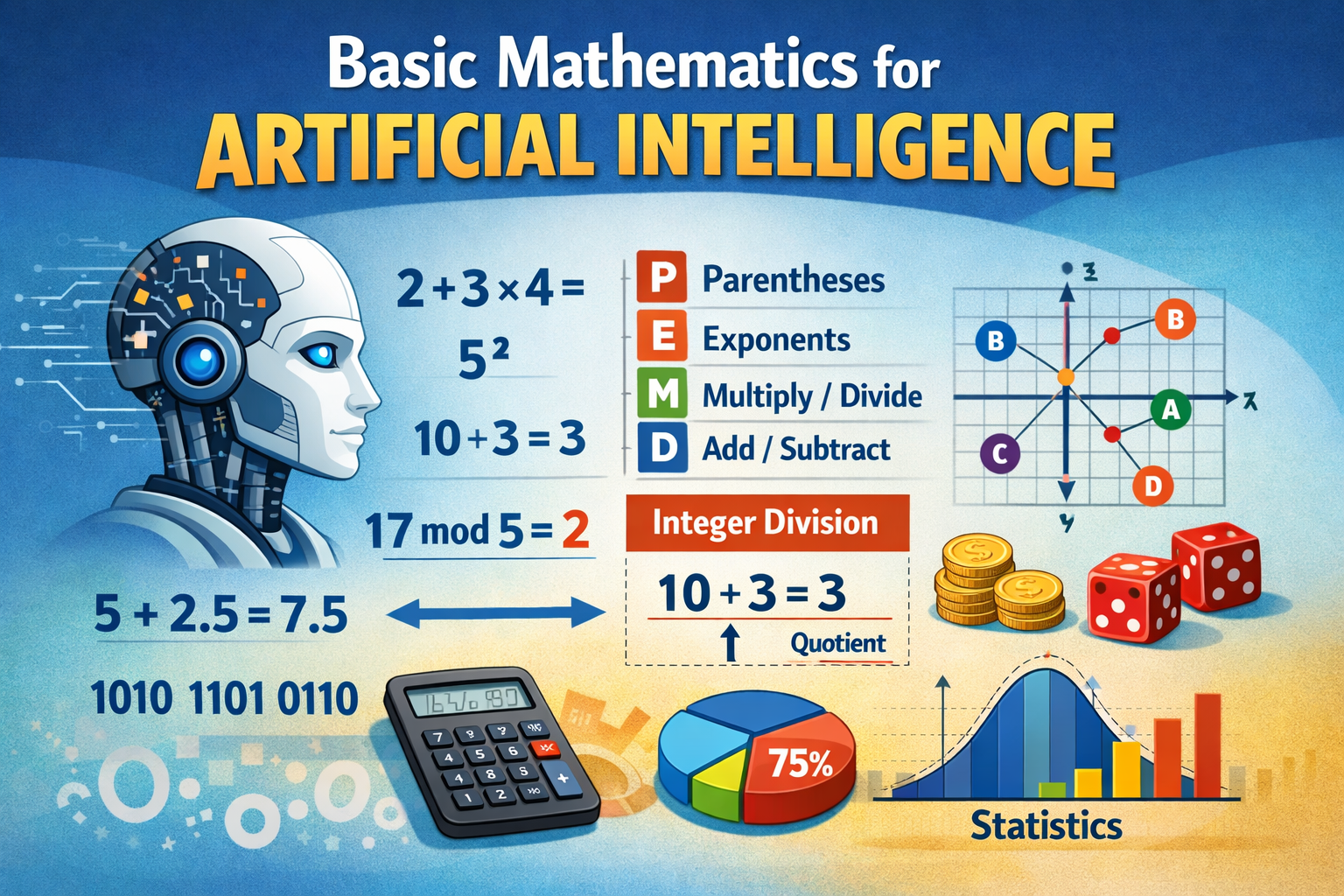
This lesson introduces the fundamental mathematical concepts used in computing and AI systems. Learners will explore mathematical operations, the correct order of operations when solving expressions, integer division, the modulus operator, and how different numeric types interact in calculations. These concepts are essential because they form the basis of how computers process numbers and execute instructions in programs.
Learning Outcomes
By the end of this lesson, learners should be able to:
- Explain the importance of basic mathematics in computing and AI
- Apply the order of operations (PEMDAS/BODMAS) correctly
- Perform and explain integer division
- Use and interpret the modulus operator in calculations
- Understand the concept of mixing data types in mathematical expressions
1. The Role of Mathematics in Artificial Intelligence
Artificial Intelligence systems rely heavily on mathematical calculations to process information and solve problems. When a computer program analyzes data, predicts outcomes, or trains a machine learning model, it performs thousands or even millions of mathematical operations.
For example:
- AI systems analyze large datasets using mathematical formulas.
- Machine learning algorithms rely on statistics and probability.
- Neural networks use linear algebra and calculus to optimize predictions.
Basic mathematical skills such as addition, subtraction, multiplication, and division provide the foundation for understanding these advanced topics.
In programming, computers follow precise mathematical rules to evaluate expressions. If the correct order of operations is not applied, the result of a calculation may be incorrect. This is why understanding mathematical structure is important in AI and programming.
2. Basic Mathematical Operations
Basic mathematics consists of four fundamental operations:
Addition (+)
Addition combines two or more numbers to produce a total.
Example:
7 + 3 = 10
Addition is commonly used in programming to combine values or update variables.
Subtraction (−)
Subtraction finds the difference between numbers.
Example:
10 − 4 = 6
Subtraction is used when calculating changes or differences between values.
Multiplication (×)
Multiplication is repeated addition of the same number.
Example:
4 × 5 = 20
Multiplication is frequently used when scaling values or calculating totals.
Division (÷)
Division splits a number into equal parts.
Example:
20 ÷ 4 = 5
Division is commonly used when distributing values or calculating averages.
3. Order of Operations (PEMDAS / BODMAS)
When solving mathematical expressions containing multiple operations, it is important to follow a specific order. If the order is not followed correctly, different answers may be produced.
The order of operations ensures that mathematical expressions are solved consistently.
PEMDAS Rule
PEMDAS is a commonly used rule to remember the order of operations:
- P – Parentheses
- E – Exponents
- M – Multiplication
- D – Division
- A – Addition
- S – Subtraction
Multiplication and division are performed from left to right, and addition and subtraction are also performed from left to right.
Example 1
Solve:
3 + 6 × 2
Step 1: Apply multiplication first
6 × 2 = 12
Step 2: Add
3 + 12 = 15
If we ignored the rule and added first, we would get the wrong answer.
Example 2
Solve:
(5 + 3) × 4
Step 1: Solve inside the parentheses
5 + 3 = 8
Step 2: Multiply
8 × 4 = 32
Parentheses always take priority in calculations.
4. Integer Division
In mathematics, division normally produces a decimal result if the numbers do not divide evenly.
Example:
10 ÷ 3 = 3.333…
However, in many computing systems, integer division is used.
Definition
Integer division is a type of division where the decimal portion of the result is removed, leaving only the whole number.
Example:
10 ÷ 3 = 3 (integer division)
The decimal part is discarded.
Why Integer Division Is Important in Programming
Integer division is commonly used in:
- Computer algorithms
- Index calculations
- Loop structures
- Data grouping
Example:
If a computer needs to divide 20 students into groups of 3:
20 ÷ 3 = 6 groups (with some remaining students)
The computer may use integer division to determine the number of complete groups.
5. Modulus Operator
The modulus operator finds the remainder of a division operation.
It is often written as mod or represented by the symbol % in programming languages.
Example
17 mod 5
Step 1: Divide 17 by 5
17 ÷ 5 = 3 remainder 2
Therefore:
17 mod 5 = 2
Example in Programming
10 % 3 = 1
Because:
10 ÷ 3 = 3 remainder 1
Practical Applications of Modulus
The modulus operator is useful in many computing tasks.
Examples include:
Checking if a number is even or odd
If a number divided by 2 has a remainder of 0, it is even.
Example:
8 % 2 = 0 → even
9 % 2 = 1 → odd
Creating repeating cycles
The modulus operator can help repeat patterns.
Example:
Days of the week cycle every 7 days.
Programming loops and conditions
Many algorithms use modulus to determine when an action should occur.
6. Mixing Types in Calculations
In mathematics and programming, calculations may involve different types of numbers.
These types include:
- Integers (whole numbers)
- Floating-point numbers (decimals)
When different types are used in a calculation, the computer often converts them automatically.
This process is called type casting.
Example
5 + 2.5 = 7.5
Here:
5 is an integer
2.5 is a decimal (floating-point number)
The system converts the integer into a decimal so that the calculation can be performed correctly.
Why Mixing Types Matters
In programming, mixing numeric types can affect:
- Calculation accuracy
- Memory usage
- Program performance
For this reason, developers must understand how different numeric types interact during calculations.
Key Concepts Summary
This lesson introduced the mathematical foundations needed for AI and computing.
Important concepts include:
- Basic mathematical operations are the building blocks of all calculations.
- Order of operations ensures expressions are solved correctly.
- Integer division returns only the whole number part of a result.
- Modulus operations return the remainder of a division.
- Mixing numeric types occurs when integers and decimals are used together in calculations.
These concepts are essential for understanding how computers perform calculations and how mathematical expressions are used in programming and artificial intelligence systems.