Lesson overview
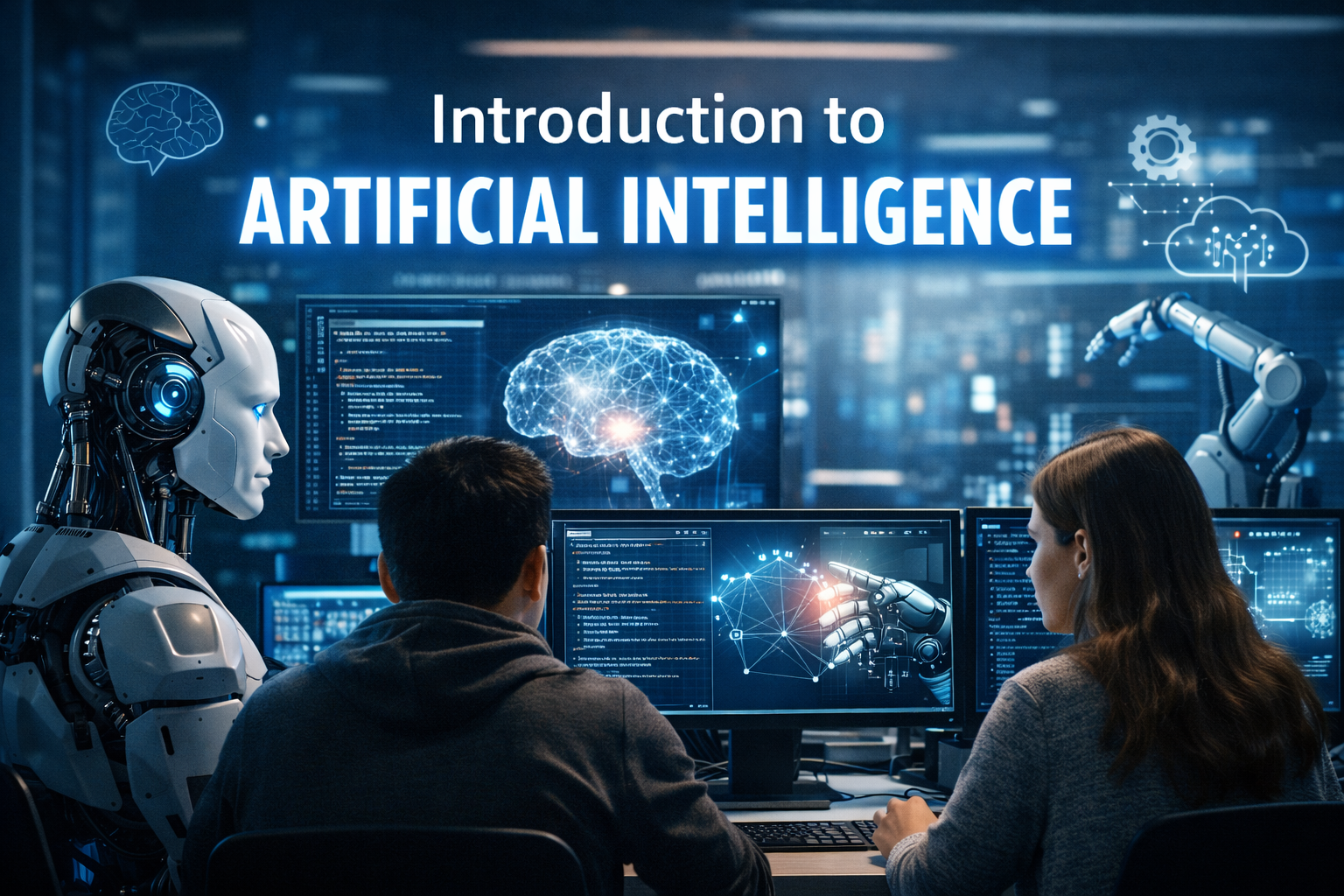
Artificial Intelligence, usually called AI, is a field of computing that focuses on building systems that can perform tasks normally associated with human intelligence. In this module, learners are introduced to what AI is, how it evolved, the main categories of AI, and the related fields that support it. The learner guide states that this section covers the evolution of AI, defining AI, realistic and unrealistic AI, related fields such as machine learning and deep learning, the taxonomy of AI, strong and weak AI, why AI is important, its contribution to society, and the future and limitations of AI.
What is Artificial Intelligence?
Artificial intelligence is defined in the learner guide as the ability of a computer or a robot controlled by a computer to do tasks that are usually done by humans because they require human intelligence and discernment.
In practical terms, this means AI systems are designed to process information, identify patterns, make predictions, solve problems, and sometimes make decisions. AI is not one single machine or tool. It is a broad field that includes many techniques and applications used in everyday life and in industry.
Examples of Artificial Intelligence
The learner guide gives examples of AI such as:
- manufacturing robots
- self-driving cars
- smart assistants
- proactive healthcare management
- disease mapping
- automated financial investing
- virtual travel booking agents
- social media monitoring
These examples show that AI is already present in many sectors and is not limited to advanced laboratories or research institutions.
The evolution of AI
According to the learner guide, AI has grown into a major technological force and is widely seen as a major revolution after the development of mobile and cloud technologies. The guide also presents seven stages of AI development:
- Rule-based systems
- Context-awareness and retention
- Domain-specific aptitude
- Reasoning systems
- Artificial General Intelligence
- Artificial Super Intelligence
- Singularity and excellency
This progression helps learners understand that AI did not appear fully formed. It developed over time, beginning with simple rule-following systems and moving toward more advanced theoretical forms of intelligence.
Realistic and unrealistic AI
The learner guide explains that present-day AI is not “real intelligence” in the human sense. Rather, it is the careful use of mathematical techniques to create the appearance of intelligence, usually focused on specific tasks. Real intelligence involves comprehension and understanding in a much broader sense.
This is important for learners because it separates hype from reality. Most systems we call AI today are specialised systems built for narrow tasks.
Fields related to AI
The learner guide identifies several related fields:
Machine Learning (ML)
Machine learning is a type of AI that allows software applications to become more accurate at predicting outcomes without being explicitly programmed for every case. It uses historical data to predict new output values.
Deep Learning (DL)
Deep learning is a type of machine learning that trains a computer to perform human-like tasks such as recognising speech, identifying images, or making predictions.
Artificial Neural Networks (ANN)
Artificial neural networks simulate aspects of human brain processes. They are associated with recent advances in areas such as image recognition, voice recognition, robotics, and other AI applications. The guide also explains that an artificial neuron is a connection point in an artificial neural network.
Data Science
Data science involves preprocessing, analysis, visualisation, and prediction. The learner guide distinguishes it from AI by explaining that data science is focused on working with data to extract insights, while AI focuses more on building predictive systems and intelligent behaviours.
Automation
The guide explains that AI is not the same as automation. Automation follows pre-programmed rules, while AI can operate within broader rules and determine pathways to success.
Robotics
Robotics is the field concerned with building machines to perform tasks, while AI is about systems that emulate human thought to learn, solve problems, and make decisions. The guide makes it clear that robotics and AI are related but not the same thing.
Taxonomy of AI
The learner guide discusses:
- philosophy of AI
- general vs narrow AI
- strong vs weak AI
Narrow AI vs General AI
Narrow AI is designed to solve one specific problem. General AI refers to a theoretical form of intelligence that can apply human-like capability across many domains.
Strong AI vs Weak AI
Weak AI focuses on specific tasks, while strong AI refers to machines that would demonstrate intelligence comparable to humans across a broader range of activities.
Why AI is important
The learner guide says AI is important because it forms the foundation of computer learning. Through AI, computers can use large volumes of data to make decisions and discoveries much faster than humans. The guide also notes that AI contributes to society by improving efficiency, making daily life easier, and supporting innovation in many industries.
Limitations of AI
The guide identifies several limitations:
- lack of good-quality data
- shortage of technical skills
- Cost of AI technologies
- maintenance and upgrade requirements
- operational and data risks if systems fail
- This helps students avoid the idea that AI is unlimited or automatically superior in every context.
Lesson conclusion
Artificial Intelligence is a broad and rapidly growing field that includes machine learning, deep learning, neural networks, data science, automation, and robotics. While present-day AI is mostly narrow and task-specific, it already plays a major role in business, healthcare, finance, transport, and everyday digital systems. Understanding its foundations is essential before moving into more advanced modules.